Category Archives: Uncategorized

Achsah: The Daughter Who Asked for More

Caleb watched as distant figures, shimmering like a mirage from the arid Negeb, gradually assumed familiar shapes, and he waited. It was his lovely daughter, Achsah, with her new husband. She was no longer under his protective care in the family compound near Hebron. She now dwelled with the one who had won her hand by his acts of bravery and courage—Othneil, slayer of giants, conqueror of Debir. Caleb wondered why they were coming.

How it all began[1]

Over forty years before, Caleb, Joshua, and ten others, leaders all of Israel’s twelve tribes, embarked on a reconnaissance of the land of Canaan, one commissioned by the LORD through Moses. Their mission? Spy out the land, and its inhabitants. Were the Canaanites a people strong, or weak? Many, or few? Did they dwell in fortified strongholds, or tents? Was the land fertile? Were there ample forests for Israel’s needs?

English: Joshua and Caleb, as in Numbers 13

English: Joshua and Caleb, as in Numbers 13 (Photo credit: Wikipedia)

It was around the month of Elul, the season for the first grape harvest. What better time to bring back samples of the ripening fruit of the land? Above all, Moses exhorted them to be of good courage. Much depended on their findings, as would soon become evident.

The twelve tribal emissaries set out immediately, and for forty days furtively scouted the land, covering some 300 miles[2] before returning to their launch point, Kadesh-barnea. En route they saw date palms, pomegranates, ripening grapes, all thriving in abundance. There was ample pasture for sheep and cattle, and fields suitable for growing barley and wheat. Olive and fruit trees dotted certain regions of countryside. The coastline provided fishing, and perhaps even dye works. Canaan, indeed, was full of resources and promise.

Its inhabitants, however, were an entirely different matter—especially the hulking sons of Anak!

An ill wind

 “We went to the land where you sent us. It truly flows with milk and honey,” the returning  spies reported to eager ears. “Nevertheless the people who dwell in the land are strong; the cities are fortified and very large; moreover, we saw the descendants of Anak there.” Amalekites, Hittites, Jebusites, Amorites, and Canaanites—all formidable and well-armed—would have to be dealt with as well.

Anak! Apprehension swirled through the ranks of Israel. Caleb quieted the people, then exhorted them, saying, “Let us go up at once and take possession, for we are well able to overcome it.” The agitators would have none of it, and retorted, “We are not able to go up against the people, for they are stronger than we. . . . The land through which we have gone as spies is a land that devours its inhabitants, and all the people whom we saw in it are men of great stature. There we saw the giants (the descendants of Anak came from the giants); and we were like grasshoppers in our own sight, and so we were in their sight.”

With weeping and wailing, Israel turned on Moses and Aaron, demanding new leaders, and refusing to enter Canaan. Moses and Aaron, in shock and horror, fell on their faces before the unruly assembly, undoubtedly recognizing a grievous affront to the LORD, their Deliverer.

Only two of the twelve, Joshua and Caleb, confronted the growing spirit of revolt, warning the tribes not to rebel against the Lord. They implored them rather to trust that “if the Lord delights in us, then He will bring us into this land and give it to us . . . .” Those words only moved the mob to violence, and cries of, “Stone them! Stone them!” filled the air. Little did the tribes of Israel realize that their own fates were sealed in the wake of that murderous intent. The LORD had had enough!

And the LORD spoke to Moses and Aaron, saying, “How long shall I bear with this evil congregation who complain against Me? I have heard the complaints which the children of Israel make against Me. Say to them, ‘As I live,’ says the LORD, ‘just as you have spoken in My hearing, so I will do to you: The carcasses of you who have complained against Me shall fall in this wilderness, all of you who were numbered, according to your entire number, from twenty years old and above. Except for Caleb the son of Jephunneh and Joshua the son of Nun, you shall by no means enter the land which I swore I would make you dwell in. But your little ones, whom you said would be victims, I will bring in, and they shall know the land which you have despised. But as for you, your carcasses shall fall in this wilderness. And your sons shall be shepherds in the wilderness forty years, and bear the brunt of your infidelity, until your carcasses are consumed in the wilderness. According to the number of the days in which you spied out the land, forty days, for each day you shall bear your guilt one year, namely forty years, and you shall know My rejection. I the LORD have spoken this. I will surely do so to all this evil congregation who are gathered together against Me. In this wilderness they shall be consumed, and there they shall die'”[3] 

To be continued…


[1] Please read Numbers 13 for the entire account.

[2] I estimate that the trip northward was roughly 150 miles based on an atlas scale. The envisioned round-trip could have covered approximately 300 miles using that scale.

By Way of Special Delivery

Note to readers: When Paul wrote, in Romans 16:1, “I commend to you Phoebe our sister, who is a servant of the church in Cenchrea, that you may receive her in the LORD in a manner worthy of the saints and assist her in whatever business she has need of you; for indeed she has been a helper of many and of myself also,” he fueled on-going curiosity as to who this woman was, and what she might have done.

 After studying a fascinating book about letter writing in the time of Paul and checking out the opinions of several commentators, I am leaning toward a couple of possibilities in this post: that Phoebe is the one who carried an important letter from Paul to the church in Rome (we now refer to it as the New Testament book of Romans), and that she went by ship.

 The following scenario might be how things actually transpired, but the Bible doesn’t identify the letter carrier or the method or means of transportation. However, there is no disputing that Paul is complimentary of Phoebe’s service to him and to the church in Corinth.

Travel arrangements   

English: Roman Ship

English: Roman Ship (Photo credit: Wikipedia)

 Phoebe’s business in Rome would take her away from Corinth a month, maybe longer. If she could get passage on a merchantman sailing directly to Rome, and the weather was favorable, it would take ten days.[1] If she went by some other means than ship, the time would be harder to estimate. Since she was uncertain how long she’d be away, Phoebe likely discussed her plans with Paul.

Paul and Phoebe were like family. She was his “sister” in Christ, dependable, competent, a worker in the faith. She served the congregation in Corinth tirelessly. She probably opened her home in Cenchrea[2] to Paul and his associates when they came to Corinth.

Perfect timing

Phoebe’s trip came at an opportune time. Paul had been unable to visit the church in Rome and wanted to get a letter to the members. She could deliver the letter and acquaint the church on Paul’s work in Corinth. With a note of introduction from Paul, the members would help her while she was in the city. Phoebe would be judicious in relating news from Corinth. When she returned to Cenchrea, Paul was undoubtedly confident she’d bring an accurate report on the brethren and their response to his letter.

A remarkable mail system

Roman Road

Roman Road (Photo credit: anfearglas)

At the time of Paul’s ministry, Rome operated a remarkable mail system. Augustus Caesar established relay stations equipped with riders, fresh horses, and light carts to carry the mail from one station to another. Men driving horse-drawn carts could carry regular mail a distance of 50 miles in a day.  Relay riders with priority mail changed horses every six miles and could cover up to 170 miles in a day.[3] Rome built 50,000 miles of paved highways throughout the Mediterranean region and 200,000 miles of secondary roads—initially to facilitate the movement of soldiers. The imperial mail system took advantage of the established routes for transporting letters pertaining to official Roman business.

Paul’s options

 Private citizens were unable to access the imperial mail system. Paul, like other citizens not officially employed by Rome, made his own informal arrangements for sending mail. The unofficial procedure for sending a letter depended on finding a family member or friend, a soldier or stranger—anyone who was willing to carry a letter to its destination. Author Randolph Richards calls the random messengers “happenstance letter carriers.” [4] If you happen to find someone going in the right direction, ask him to take your letter. It was a somewhat reliable way of sending and receiving mail, because it was the only option private citizens had at the time. Wealthy individuals hired slaves who were trained letter carriers or employed them as part of the household staff.

Richards states that Paul may have depended on happenstance carriers early in his ministry but later relied on fellow Christians. “From 1 Corinthians onward, Paul’s letters were carried by named, private letter carriers, who bore Paul’s endorsement and whom Paul said had authority to elaborate his meaning (Col 4:7-9).”[5]

Paul’s commendation

At the end of his letter, Paul recommends Phoebe to the church members in Rome. He states that she is a “sister,” a believer in Christ, and a servant of the church in Cenchrea. The members understood that her service would have included visiting the sick, helping women with family needs, teaching children, caring for elderly widows and extending hospitality. Paul states “she has been a helper of many and of myself also” (Rom.16:1-2).

Paul trusted the church to befriend Phoebe while she was in Rome “in whatever business she has need of you” (Rom.16:2). When Phoebe sailed from Corinth, she was confident of connecting with fellow Christians who would look after her.

Scripture doesn’t say anything about Phoebe’s voyage, the success of her business, her relationship to the congregation or how the church assisted her. All we know is that the letter arrived in Rome.

Helpful or significant?

The significance of delivering the letter relates to the value of it. If Paul had written a simple announcement of his intention to visit Rome, the carrier’s service would be remembered as helpful. I believe Phoebe carried the letter, and what elevates her service to significant is the extraordinary nature of the letter itself, which is underscored by the following sources:

  • By common consent, Romans is the greatest of Paul’s letters. (The Expositor’s Bible Commentary, Vol. 10, p.3)
  • The greatest of Paul’s epistles and considered by many as the greatest book in the NT…it is a book, in one sense, simple and clear, but in another sense so magnificent that it baffles complete comprehension. (The New Unger’s Bible Dictionary, p. 1088)
  • Romans is a masterful presentation of God’s plan of salvation for Jews and Gentiles. (NKJV Study Bible, p.1764)
  • This letter has also loomed large in the history of Christianity. Countless men and women of faith have singled out Romans as the weapon God graciously used to bring about their surrender to Christ. (Same source, p.1763)

A very special delivery

 If Phoebe was indeed the carrier, she had the privilege of delivering what is now commonly considered Paul’s most significant epistle. Did she hear the very first reading of the letter aloud in church? I imagine she was thankful to God for her small part in bringing such amazing good news to the church in Rome. —Mary Hendren


[1] Paul and First-Century Letter Writing, E. Randolph Richards, p. 199 (note on estimated time for a letter to reach Rome, via ship from Corinth)

[2] The Woman’s Study Bible notes that Cenchrea was a seaport for Corinth (p. 1890).

[3] “Mail,” Wikipedia

[4] Paul and First-Century Letter Writing, Richards, pp. 178-179

[5] Same source, p. 208

Dear Dr. Luke

I suppose everyone has a favorite section or book of the Bible. I have several, among them the writings of Luke. I decided to write him a letter to thank him for enriching my studies, especially about a certain woman.

Dear Dr. Luke,

Sometimes when I read through the Bible I happen on something that makes me wish I could say “thank you” to the author. It’s a little hard to do, since so much time has elapsed and I live in a different phase of the Church; but I decided to write to you anyway to express my appreciation for the books you wrote and especially for the details you recorded about some of my favorite people—particularly women.

When I leaf through your Gospel in my Bible, I notice that it has pink pencil highlighting (my color code for women) sprinkled on its pages from beginning to end.

You see, I’ve read and reread these words many times before. I know women were sometimes not too highly esteemed when you lived, but you included them, as God led you to, in the real-life settings of your time. I find your book an exclusive edition in some ways, and I’ll tell you why.

A case in point: Mary the mother of Jesus

Without you, I would not have known many of the extraordinary details of Mary’s life: Gabriel’s amazing visit to her that remarkable day; John the Baptist leaping in his mother Elizabeth’s womb when she came for a visit; and her prophetic prayer. You managed to capture the moment, allowing me to “look over your shoulder” in the process. And with each reading I seem to learn something new. What a gift God gave you!

Only you gave me a glimpse of the aged Simeon bestowing a blessing on the tiny, newborn Jesus, allowing me to “hear” his solemn words to Mary. Why, in only three short verses you condensed the entire life of the aged prophetess Anna, herself an eye-witness to Simeon’s blessing. How masterfully you wrote.

I sometimes wonder why Matthew and Mark didn’t mention the episode where the youthful Jesus went missing after the feast of the Passover. That might have made front-page news in our town today. I’m glad you recorded the happy but surprising ending.

A couple of times you seemed to have been privy to Mary’s private thoughts—things she kept in her heart (Luke 2:19, 51)—as she struggled to comprehend the divine workings in her life. These intimate details touch me in such an inspiring and compelling way.

A real wireless connection  220px-Scribe_tomb_relief_Flavia_Solva

In this day of computers and word processing, it is hard for me to realize that you did not have access to paper or printers. You had no laptop, iPad, camera or Internet. You probably carried wax tablets or washable papyrus notebooks with you wherever you went to keep notes of interviews or first-person accounts or to jot down the facts. (I sometimes envision you as a kind of first-century man-on-the-street reporter with stylus in hand.)

It wouldn’t surprise me to learn that you sometimes used a type of shorthand—Paul’s secretaries apparently did. Whatever the method, I’m confident it was cutting-edge for the day.

Letter by letter

Patience must have been one of your chief virtues because I read once that it took lots of time to write a manuscript like the one you presented to Theophilus (Acts 1:1). In fact, someone estimated that it took two to three days to make each hand-written copy of your friend Paul’s letter to the Romans (Paul and First-Century Letter Writing, E. Randolph Richards, p. 165), and that didn’t include all the preliminary drafts and edits. I would call that a true labor of love!

The front side of folios 13 and 14 of a Greek ...

The front side of folios 13 and 14 of a Greek papyrus manuscript of the Gospel of Luke containing verses 11:50–12:12 and 13:6-24, P. Chester Beatty I (Gregory-Aland no. P 45 ). (Photo credit: Wikipedia)

You would be happy to know that your writing has endured through the ages intact and is highly revered yet today.

That extraordinary Day of Pentecost

If the hallmark of a good book is wanting to read it over and over, your books certainly meet that standard for me. This year, as I was rereading the first chapter of your The Acts of the Apostles, these words especially caught my attention: “These all continued with one accord in prayer and supplication, with the women and Mary the mother of Jesus, and with His brothers” (Acts 1:14).

Thank you so much for that verse, because you are the only one who let me know the rest of the story about Mary. It is comforting to learn that she survived the horrifying ordeal of seeing her Son die—that she was there with the rest, praying and faithfully waiting for the fulfillment of her Son’s promise : He was going to send the Comforter.

At some future date

If we ever have the chance to meet sometime in the future, I’ll be eager to learn more of the details about Mary’s reactions to that momentous Pentecost and the manifestations of God’s Holy Spirit working in and energizing the fledging Church of God.

Until then, with gratitude from your ardent admirer and student…KM

(This post first appeared in the Godly Women Blog, June 14, 2011.)

Barley: the Grain of the Poor

Barley was the grain most commonly used to mak...

Barley was the grain most commonly used to make into flour for bread in Iron Age Israel. (Photo credit: Wikipedia)

Barley was a primary food grain in ancient Israel. The Israelites planted barley in the fall at the time of first rain. The seed over-wintered in the ground, sprouted in the spring and was harvested in March to April. Wheat was planted at the same time but it ripened in May to June. Barley could be grown in poor soil and be broadcast into unplowed ground. Barley was a dependable, disease-resistant crop, easier and less expensive to grow than wheat.

Concerning nutrition, barley surpasses wheat in a few ways: barley has twice as many fatty acids as wheat; it has 40% more fiber than wheat; it contains vitamin E (wheat has none); it contains more thiamine, riboflavin and lysine than wheat “giving barley a more balanced protein.”[1] Barley has less gluten than wheat, which makes it less desirable for making raised breads. The high gluten content of wheat, and the preference for raised bread, caused wheat to become the most important of the ancient grains.

Israel’s bread

Though wheat became the preferred grain in the ancient world, barley still played an important part in the diet of the Hebrews. Israelites ate barley and oats as porridge and flatbreads and fed both grains to their animals. Wheat was not used as animal food. Barley gradually became known as the grain of the poor. “Barley was cultivated in Palestine and Egypt and was fed to cattle and horses. Though the Egyptians used barley to feed animals, the Hebrews used it for bread, at least for the poor.”[2] Barley was fed to horses or mixed with ground lentils, beans and millet to enhance its taste.[3]

It is estimated that bread provided “50-70 % of the ordinary person’s calories, and the bread eaten until the end of the Israelite monarchy was mainly made from barley.”[4] The book of Ruth illustrates the importance of barley as a life sustaining grain for the poor.

Gleaning 

Jan van Scorel, Ruth and Naomi in the fields o...

Jan van Scorel, Ruth and Naomi in the fields of Boaz. (Photo credit: Wikipedia)

 Ruth and Naomi had no way of supporting themselves in Moab, so they returned to Israel as impoverished widows. (Ruth 1:20). They arrived at the time of the barley harvest, and found relief through laws established to help the poor (Ruth 1:22, Lev. 19:9, Lev. 23:22, Deut. 24:19).

When you reap your harvest in your field, and forget a sheaf in the field, you shall not go back to get it; it shall be for the stranger, the fatherless, and the widow, that the LORD your God may bless you in all the work of your hands. When you beat your olive trees, you shall not go over the boughs again; it shall be for the stranger, the fatherless, and the widow. When you gather the grapes of your vineyard, you shall not glean it afterward; it shall be for the stranger, the fatherless, and the widow. And you shall remember that you were a slave in the land of Egypt; there I command you to do this thing.

 Gleaners were allowed into the fields after a farmer had harvested his crop, and farmers were subject to punishment if they frustrated those who wished to collect leftover crops. Ancient rabbinical rules stated that farmers were “not permitted to discriminate among the poor, nor to try to frighten them away with dogs or lions.”[5]

Ruth was blessed to glean in fields belonging to Boaz, a kind and generous man. His reapers purposefully dropped barley for Ruth to pick up, enabling her to gather more than would have been expected. In the evenings, she returned to Naomi with about half a bushel of barley.

Threshing

Each village had a threshing floor that the farmers shared. A threshing floor made of paving stone or hard-packed dirt was located in flat, windy areas. Farmers piled their sheaves on the threshing floor and cattle trampled over the grain to break up the straw. At some threshing floors, farmers hooked oxen to threshing boards embedded with obsidian chips or to spiked rollers. Both mechanical devices were pulled across the sheaves to break the grain heads free of the straw. Because Ruth gleaned a small amount of grain each day, it is likely she threshed by beating the grain with a hinged tool called a flail.

A threshing flail Français : Fléau ‪Norsk (bok...

A threshing flail Français : Fléau ‪Norsk (bokmål)‬: Slegel (nn), sliul (nn/nb), sloge (nn), tust (nn/nb) Svenska: Slaga Română: Îmblăciu (Photo credit: Wikipedia)

Farmers tossed the threshed grain into the air with winnowing forks, allowing the wind to blow away the chaff. Women winnowed by tossing and catching the grain in flat baskets. Ruth likely winnowed her grain in a flat basket, keeping her part separate from the harvest.

Grinding

In the evening Naomi and Ruth divided the grain into portions: what would be used immediately, what would be stored and what would be sold for other commodities. They parched grain and ate it warm. They parboiled it for porridge or stew.  They ground most of it into flour for bread.

I imagine that Naomi took care of the grain that Ruth brought home. The most arduous of her duties was grinding. Grinding “was a difficult and time-consuming task…it is estimated that it required at least three hours of daily effort to produce enough flour to make sufficient bread for a family of five. The earliest milling was performed with a pestle and mortar, or a stone quern consisting of a lower stone that held the grain and a smooth upper stone that was moved back and forth over the grains.”[6] Working with a quern or pestle and mortar, it may have taken Naomi an hour or more of grinding to make enough flour for their daily bread.

Busy hands reap bountiful blessings

Ruth and Naomi worked to support themselves. They were grateful for the opportunity to work. Ruth came to the attention of Boaz because she had worked (Ruth 2:11).

It has been fully reported to me, all that you have done for your mother-in-law since the death of your husband, and how you have left your father and your mother and the land of your birth, and have come to a people whom you did not know before.

 God blessed Ruth because she continued to work (Ruth 2:12, 4:13-17).

The LORD repay your work, and a full reward be given you by the LORD God of Israel, under whose wings you have come for refuge. ♦ Mary Hendren


[1] AAOOB Storable Foods, Grain Information, “Barley ”

[2] Illustrated Manners and Customs of the Bible, Packer and Tenny, Editors, p. 468

[3] Six Thousand Years of Bread, H.E. Jacob, pp. 35, 163

[4] Wikipedia, “Ancient Israelite Cuisine

[5] Wikipedia, “Gleaning”

[6] Wikipedia, “Ancient Israelite Cuisine”

Sorting Out the Marys

Have you ever noticed how often the name “Mary” appears in the New Testament, particularly in the Gospels? My electronic Bible program finds 54 matches when I do a search for the term Mary. Contained within the search results are references to seven individuals with the same name–Mary–but this post will show that each had her own unique, memorable part to play in the ministry of Jesus and the formation of what became the Church of God. Sometimes the challenge is in sorting them out.

Why choose Mary?

A friend posed an interesting question when I told her about my topic: Why was the name Mary so popular in New Testament times, given its association with the name Mara, Naomi’s way of describing her affliction (Ruth 1:20), and Marah, the name of the bitter water the Israelites once encountered in their wilderness wanderings (Exodus 15:23)? Herbert Lockyer comments that the “original and pervading sense of these root forms is that of ‘bitterness,’ derived from the notion of ‘trouble, sorrow, disobedience, rebellion’” (All the Women of the Bible, p. 92). Why would a parent give a daughter such a name, she puzzled.

Foreshadowing or preference?

Experts are divided as to the reason for such a choice. Some guess that the naming stemmed from the high regard for Miriam, older sister of Moses and Aaron, and heroine of ancient Israel. Others think it possibly due to the popularity of Mariamne, the last representative of the Hasmonean family.

When I stop to consider Mary, the mother of Jesus, I feel her life certainly had its share of bitterness and sorrow. Perhaps the aged Simeon alluded to the meaning of her name when he said, “…yes, a sword will pierce through your own soul also” (Luke 2:35).

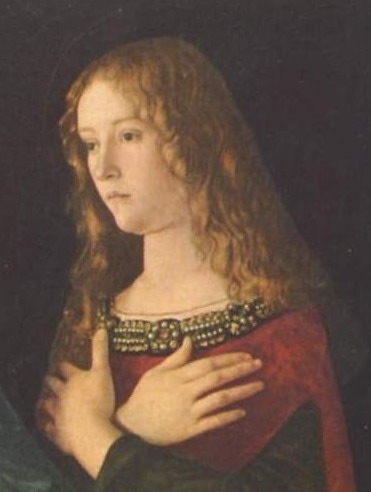
Giovanni_Bellini_Mary_Magdalene

Mary Magdalene by Giovanni Bellini

Who is who?

In this post we’ll take a look at each of the Marys in her particular context using the chart below.

Sorting Out the Marys of the New Testament

Mary Scriptural references    Biographical Notes
the mother of Jesus Matthew 1 & 2

Luke 1 & 2

John 2:1-11

Matthew 12:46

Mark 3:21, 31

John 19:25

Acts 1:14

  • A Jewish virgin betrothed to Joseph, the son of Heli.
  • Mary was from the small village of Nazareth.
  • Gabriel visited her with the news that she, a virgin, would conceive a Son Who would be named Jesus.
  • Mary’s cousin, Elizabeth, miraculously conceived in her old age, and bore a son, John the Baptist.
  • She witnessed her Son’s ministry, experienced at least one of His miracles, and was present at His crucifixion.
  • The last mention of Mary is found in Acts 1:14 where she is listed among the disciples gathered in an upper room before the momentous Day of Pentecost when the Holy Spirit was given.
Magdalene Matthew 27:55-56, 61

Matthew 28:1, 8-10

Mark 15:40, 47; 16:1, 9

Luke 8:2; 24:10

John 19:25; 20:1, 14-18

  • She was probably from the town of Magdala, about three miles north of Tiberias.
  • Jesus cast seven demons out of her.
  • She was among several women who traveled with Jesus and His disciples, providing for Him “out of their substance” (Luke 8:3).
  • Most agree that she is not to be identified as the sinful woman of Luke 7:36-40. (See the International Standard Bible Encyclopedia (ISBE), topic “Mary,” specifically “Mary Magdalene” as an example.)
  • She saw Jesus crucified; she stayed with the body until it was taken down, wrapped in linen cloth, and placed in the tomb.
  • She was among the women who brought spices to anoint Jesus’ body, and discovered that He had risen.
  • Mary Magdalene is specifically mentioned eleven times in the New Testament.
the mother of James the Less and Joses Matthew 27:56,61

Matthew 28:1

Mark 15:40, 47; 16:1

Luke 24:10

John 19:25

  • There is some interesting discussion among scholars concerning this woman. John 19:25 calls her Mary, the wife of Clopas (Cleophas), and mentions that she was Mary’s (the mother of Jesus) sister.
  • Unger’s Bible Dictionary (PC Study Bible edition) has the opinion that Mary of Clopas and Mary the mother of James and Less and Joseph (Joses) are the same person, and that she was the sister of Mary, the mother of Jesus.
  • As for sisters having the same name, Unger offers an explanation that on close examination of the Greek text, the virgin Mary’s name is Mariam; her sister’s name is Maria. (See topic Mary, sub-topic Mary Wife of Clopas.)
  • ISBE (PC Study Bible) comments that Clopas is also the Alphaeus mentioned in Matthew 10:3 as the father of James. Not all sources agree, however.
  • ISBE also suggests the possibility that this Mary was the older sister or half-sister of the virgin Mary.
the other Mary Matthew 28:1
  • She came to the tomb with Mary Magdalene.They encountered an angel who explained that Jesus had risen from the dead, and told them to bring the word to His disciples.
  • A commonly held opinion is that this Mary is the wife of Clopas, and mother of James the Less and Joses. There is some disagreement as to her identity.
of Bethany Matthew 26:7-13

Mark 14:3-9

Luke 10:38-42

John 11:1,5; 12:1-12

  • This Mary is the sister of Martha and Lazarus.
  • She is the one who anointed Jesus’ head with spikenard, foreshadowing His death and burial.
  • She is not the “sinner” who anointed Jesus’ feet in Luke 7:37.
  • She sat at Jesus’ feet for instruction in spiritual matters.
the mother of Mark Acts 12:12
  • The ISBE suggests this Mary was probably the aunt of Barnabas. It also comments that possibly she was “a wealthy widow of Jerusalem, who upon becoming a disciple of Christ, with her son, gave herself with whole-souled devotion to Christian service, making her large and well-appointed house a place of meeting for the proscribed and homeless Christian communion whose benefactor and patron she thus became” (PC Study Bible, ISBE, topic Mary, sub-topic “Mary, the Mother of John Mark”).
of Rome Romans 16:6
  • Paul mentions her as one who “labored much for us.”

Bread

The first Biblical reference to a woman doing specific work (other than childbirth) refers to a task done four thousand years ago. Abraham entertained unexpected guests, and Sarah made cakes for them.

So Abraham hurried into the tent to Sarah and said, “Quickly, make ready three measures of fine meal, knead it and make cakes.”

 Women made cakes from meal, or fine meal (flour), and “roasted the dough in the ashes” or “under the coals” or on hot stones.[1] The ancient people used four kinds of grain to make meal: millet, oats, barley and wheat. Sarah could have made cakes from any of the grains, although barley and wheat were preferred. Barley meal made healthful roasted flatbread and became a symbol of Israel’s strength.

“Nowhere—not even in Homer—is there written so forcible a tribute to barley as in the Book of Judges, where an Israelite dreams of a cake of barley bread tumbling into the Midianites’ camp and destroying all of Israel’s enemies.”[2]

Barley

Barley (Photo credit: freefotouk)

While barley, millet and oats make satisfying flatbreads, these grains have little or no gluten, which is necessary for making raised bread. Millet is gluten-free; oats contain a little gluten; and barley has less gluten than wheat. Because of its high gluten content, wheat flour makes exceptional raised bread. Kneading dough made from wheat flour develops strands of gluten. Gluten is stretchy and traps the gas generated during leavening. It enables bread to rise and hold its structure. Raised bread can be made with other grains if they are combined with wheat flour or another gluten source. Because of wheat’s baking qualities, it “became the king of grains—and remains so to this day.”[3]

Sarah’s Cakes

Did Sarah know how to make raised bread from air-borne yeast? She might have. Historians believe that Egyptians “invented” raised bread about 500 years before the time of Abraham.

Egyptian Bowl with Bread

Egyptian Bowl with Bread (Photo credit: feministjulie)

 “Around 2,500 B.C. the Egyptians learned how to exploit the gluten in wheat flour making the first raised breads from yeast. This discovery alone pushed wheat to the forefront ahead of the other prized grains of the day, oats, millet, rice and barley. The Egyptians grew huge amounts of wheat. They eventually started exporting wheat to other parts of the new world.”[4]

The Egyptians “made an enormous contribution to civilization” by setting aside their dough until it fermented, and “were known as the bread eaters…[because it was] the principal good of all Egyptians.”[5]

How the Egyptians first discovered the activity of invisible air-borne yeast is not known. Was an Egyptian woman called away from mixing her dough long enough that yeasts began to ferment it? When she returned and found a slightly bubbly mess, did she throw up her hands and say, “I’ll have to bake it anyway.” It’s lost to us.

Learned skill

 It is likely that the Israelites learned to make raised bread while they were slaves in Egypt. At the time of Moses, Egyptians already had brick ovens and were capable of making raised breads in various shapes, a skill attested to by Egyptian tomb paintings.  Earlier Hebrews, nomadic peoples like Abraham who lived in tents and followed their herds, “could not be bothered transporting such ovens through the land…either they parched the grain, like the reapers in the Book of Ruth, or they set flat cakes to bake” on a hearth or under coals.[6]

Adam Clarke states that Sarah made cakes on a hearth as was common among the Bedouin tribes. “When the hearth is strongly heated by the fired kindled on it, they remove the coals, sweep off the ashes, lay on the bread, and then cover it with hot cinders.”[7] Commentators John Gill and Jamieson, Fausset and Brown agree with Clarke that Sarah made cakes from sifted meal and cooked them on a hot surface under embers.

Time to Rise

It is stated on some Jewish websites that flour made from any of five basic grains (wheat, oats, rye, barley and spelt) and mixed with water begins to be leavened by natural yeasts in 18 minutes. Orthodox Jews, who seek to avoid any chance of dough beginning to ferment, bake their Passover matzohs quickly. Wild yeast will begin fermenting sugar when it settles on hydrated flour. But it takes more than 18 minutes of yeast activity to achieve dough sufficiently strong for baking a sizable raised loaf.

Peter Reinhart in The Baker’s Apprentice describes preparing an initial “seed culture” of wild yeast, flour and water over a period of one to four days. A small portion of this starter culture is mixed into a measure of flour and water to make a loaf of sourdough bread. After the dough is kneaded to develop gluten, it rests two to four hours as the yeast works. After resting, the dough is shaped and rises a final time before being baked.[8]

No Time to Rise

Ancient Israel had to leave Egypt quickly. After God administered the tenth plague, He wanted Israel out in a hurry. They couldn’t wait the hours to leaven, knead, shape, rise and bake their dough in Egyptian ovens. As stated in Exodus 12:33-34, the Israelites left with unused kneading bowls on their shoulders. Their daily bread was leavened but they didn’t have time to prepare it.

And the Egyptians urged the people, that they might send them out of the land in haste. For they said, “We shall all be dead.” So the people took their dough before it was leavened, having their kneading bowls bound up in their clothes on their shoulders.”

 A remarkable sign

Israel learned to make leavened bread in Egypt. Women baked it every day. It was a staple of their diet.

It was a remarkable sign for the Israelites to leave the land of “bread eaters,” the people who “invented” raised bread, who built brick ovens, who made fanciful shaped loaves, who baked bread for their gods and ancestors—to depart without any of the bread of Egypt.—Mary Hendren


[1] Six Thousand Years of Bread, H.E. Jacob, p.35.

[2] Same source, p. 15.

[3] Same source, p. 15.

[4] http://www.aaoobfoods.com, “Grain Information”

[5] Six Thousand Years of Bread History, pp. 26, 31

[6] Ibid, p. 35

[7] Adam Clarke’s Commentary, note on Gen.18:6, p. 42

[8] The Bread Baker’s Apprentice, Peter Reinhart, pp. 227-235

The Many Facets of Miriam

Caregiver

Miriam was born in Egypt. Her parents, Amram and Jochebed, were Hebrew slaves in Pharaoh’s work force. Miriam was the oldest of their children, and she helped care for her younger siblings. As a child, she was responsible, nurturing, and assertive.

Sometime after Amram and Jochebed married, Pharaoh ordered a massive infanticide. He intended to control the slave population by systematically killing Hebrew male infants. Amram’s second child, Aaron, may have been born before the edict went into effect because he was already three years old when the story begins.  The edict was in force, however, when the second son was born. Sympathetic midwives did what they could to save the infants, but Pharaoh eventually required all Egyptians to take part in the killings. When all Egyptians were on the lookout, it was difficult to conceal any boys the midwives saved. Read the rest of this entry

Two Mothers, One Son

In a previous post, we considered the identity of Pharaoh’s daughter and concluded there does not seem to be enough evidence to settle on any one name with confidence. However there is information about daughters of pharaohs in general which could have a bearing on the Moses story.

Who is her mother?

Though we can’t answer the following conclusively, we’ll explore a couple of general questions regarding this elusive princess:  who her mother was, and where she might have lived. If she was a daughter of Pharaoh’s principal wife, it’s probable that she would have lived in the environs of the royal palace. If, however, she was the daughter of a secondary wife, she and her mother could have taken up residence in one of many royal compounds scattered throughout Egypt. In that case, Pharaoh would visit or call for them as he desired.

“‘The pharaohs of the New Kingdom period (c. 1570-1085 B.C.) maintained residences and harim not only in the great capitals of Thebes, Memphis, and Pi-Ramesse (Ra’ amses) but also in other parts of Egypt, especially in pleasure resorts….Papyrus documents indicate that this Harim was no prison of enforced idleness for its inmates in pharaohs [sic] absence; the royal ladies supervised a hive of domestic industry, spinning and weaving done by servants….’”[1]

Women of substance

Some may wonder about the role of women in Egypt.  According to Nahum M. Sarna, in his book, Exploring Exodus (1986),  the social and legal position of an Egyptian woman was considerable. “Descent was strictly matrilineal, so that property descended through the female line. This meant that the woman possessed inheritance rights and could dispose of property at will. As a result, she enjoyed a certain measure of economic independence” (p. 31).  It should not seem strange that Pharaoh’s daughter made several on-the-spot decisions with confidence and without apparent reservation (Ex. 2:1-10), likely based not only on her position generally, as a woman in Egyptian society, but especially on her place within the royal family.

The princess commissions a wet-nurse

Wet-nurses were hired to care for foundlings. Ancient Mesopotamian legal texts provide specifics for proper payment regarding such services. Typically, a wet-nurse suckled and reared a child in her home for a specified period of time, usually two to three years, until it was weaned. Then it was returned to the finder for adoption.[2]

The account in Exodus 1 records an interesting departure from the normal procedure. Royal wet-nurses were generally members of elite families, perhaps wives or mothers of high officials. This connection brought with it a certain prestige, one which could result in possible advancement in rank for their husbands and sons.[3] For Pharaoh’s daughter to listen to a young Hebrew girl and follow her suggestion to enlist the services of an unknown woman, represents, to my mind, evidence of the providence of a much higher Power in this whole episode.

Moses and Jochebed

Moses and Jochebed (Photo credit: Wikipedia)

The role of Jochebed

Of course, there is no doubt as to Jochebed’s ability to nurse her own baby. Her breasts were probably aching for relief by the time Moses was once more in her arms. However, what she might have done additionally, in the long term, is well worth contemplating.

There are those who speculate that this mother had carefully planned for her baby’s rescue, positioning him deliberately in a place where Pharaoh’s daughter would find him.[4] Why, one might wonder. Had she secretly watched this princess over time, and knew vicariously her disposition for kindness? Did she have a God-given understanding that hers was no ordinary son and that his future would require the best education the world of her day could offer?[5] Did she feel that the safest place for him would be in the care of this royal princess–one whom Jochebed knew to be influential and strong-minded enough to set aside her father’s bloody policy?

Training her child

Others discuss a different matter. Since Jochebed likely had Moses for three years or longer, what did she do during that time? Several feel she carefully laid a foundation for his eventual worshipping of the God of Israel. She was a daughter of Levi (Ex.2:10) and according to one source her name (Hebrew yokebed) apparently means “YHWH is glory.” She is noted as the first person in the Bible to have a name with the divine element yah, a shortened form of YHWH.[6] Does her name indicate that she came from a family of believers who worshipped the true God? Such a notion seems worth considering.

Jamieson, Fausset and Brown Commentary offers the following opinion concerning Ex. 2:10: “His [Moses’s] age when removed to the palace is not stated; but he was old enough to be well instructed in the principles of the true religion; and those early impressions, deepened by the power of divine grace, were never forgotten or effaced. He had remained long enough to be thoroughly imbued with the true national feeling of a Hebrew; and though he may have actively engaged in the varied scenes to which his royal station afterward introduced him, he never ceased to cherish a spirit of sympathy with the race from which he had sprung.”[7]

If the ruling pharaoh was indeed Thutmose III, he worshiped a form of the sun god (sometimes depicted as a sphinx), Amun-Re. It would have been important to introduce knowledge of the true God of Israel to Moses early on. Stephen, in Acts 6:20, says “Moses was born and was well-pleasing to God,” indicating that God was already involved in his life, beginning with his brave and faithful mother.

Grooming a royal prince

While Jochebed likely concentrated on the religious upbringing of her young son, his adopted mother provided the means for a formal education. At about the age of four, boys in the royal court began attending school from early morning until noon–a routine lasting for approximately twelve years. Strict discipline was maintained, backed up with corporal punishment. “The school curriculum largely centered on reading, writing, and arithmetic,” with writing being especially important. “The art of penmanship and the cultivation of style were both highly esteemed as the indispensable prerequisites for a sound education. Drill and memorization seem to have been the chief pedagogic techniques.”[8]

As for Moses’s childhood, John Davis writes: “Children were generally carefree, and played much like children do today….Swimming, horseback riding, hunting, playing with household pets would all be part of the experiences of a young boy in Egypt.”[9] 

Mummy Portrait of a Boy

Mummy Portrait of a Boy (Photo credit: Taifighta)

The young prince would have sported the typical haircut for Egyptian boys of his day—a shaved head except for one long lock on the side, which was braided.[10]

Teen to early adulthood

Moses undoubtedly spent much time perfecting his skills at archery and horsemanship—both favorite pastimes of that dynasty. Learning languages and the geography of his land would have been important as well. Slowly and surely he was being equipped with skills that would serve him in the challenging days to come. In Davis’s words, what we know is a “remarkable example of the excellency of the providence of God” (p. 56).

One last piece

Moses spent forty years in Egypt before he went into exile in Midian. We’ve managed to piece together a collage of what life might have been like into his early adulthood. The Jewish historian Josephus records another bit of his story in The Antiquities of the Jews, Book 2, Chapter 10. According to his account, when Moses had reached full maturity, he was appointed general of the Egyptian army, went against their enemies, the Ethiopians, conquered them, and returned victorious. The Bible nowhere mentions this activity.

One yet to come

So far we have noted five memorable women whose presences figured prominently in the epic story of Moses: Shiphrah and Puah, Pharaoh’s daughter, Jochebed, and Zipporah —all heroic figures, all courageous in dangerous times.

One woman yet remains—Miriam—the subject of our next post.


[1] Citation in Moses and the Gods of Egypt (1971), John J. Davis, p. 52.

[2] See Exploring Exodus, p. 32.

[3] Women in Ancient Egypt (1993), Gay Robins, p. 89.

[4] See Barnes’ Notes and Jamieson, Fausset and Brown Commentary regarding Ex. 2:4-5.

[5] Josephus seems to think so. See The Antiquities of the Jews, Book 2, Chapter 9.3; 9.4.

[6] Women in Scripture (2000), Carol Meyers, Gen. Ed., p. 103.

[7] Jamieson, Fausset, and Brown Commentary, Electronic Database. Copyright © 1997, 2003 by Biblesoft, Inc.

[8] Exploring Exodus, p. 33.

[9] Moses and the Gods of Egypt, p. 55.

[10] Ibid. Davis comments that this hairstyle was actually found on a mummy of a young boy.

A Woman Named Zipporah

We first meet Zipporah at a well in Midian where she and her sisters watered their father’s flocks. On that day, Moses stepped in to defend the women from brutish shepherds who had driven them away from the well. Moses watered the flocks and later accepted the hospitality of Jethro, Zipporah’s father.

Moses Defending the Daughters of Jethro

Moses Defending the Daughters of Jethro (Photo credit: Wikipedia)

Based on his dress and grooming, Moses appeared to be an Egyptian (Ex.2:19). He was born in Egypt and was the adopted son of Pharaoh’s daughter. Moses had lived a princely life until, in a fit of anger, he killed an Egyptian.  To escape the wrath of Pharaoh, Moses fled to Midian. The day he met Zipporah, Moses was an exile from home, the natural son of Hebrew slaves, and a man without a country.

Jethro took Moses into his family. The two of them seemed to get along amiably. In time Jethro arranged a marriage between Moses and Zipporah. Moses named their first son Gershom, foreigner, because Moses considered himself, “a foreigner in a foreign land” (Ex. 2:22). Over the next forty years, Moses cared for the flocks of his father-in-law.

Jethro was a priest in Midian. There was some similarity between the religious beliefs of Jethro and Moses, because both men traced their roots back to Abraham…and the God of Abraham. But there were differences in how they understood God’s will, such as the proper manner of circumcision. “The Midianites practiced circumcision on a groom right before his marriage instead of circumcising male infants.”[1] The difference in the timing of circumcision[2] became the occasion of a harrowing event.

As Moses, Zipporah and their sons were on the road to Egypt, God suddenly confronted Moses and “sought to kill him” because Moses had neglected to circumcise his son. Zipporah, realizing that her husband’s life was at stake, grabbed a sharp stone and circumcised the child herself (Ex.4:24). Then she threw the foreskin at Moses’ feet, saying,

Surely you are a husband of blood to me!  You are a husband of blood![3]

Back to Midian

Moses later sent his wife and sons back to live with Jethro. It may have been that Zipporah instigated the separation after the ordeal with God. It appears they did not see Moses again until a few months after Israel had left Egypt. Jethro, Zipporah and the two sons visited Moses at a campsite near Mt. Sinai (Ex. 18). They stayed together as a family and discussed what had happened in Egypt. The elders of Israel joined them for meals. Jethro remained long enough to advise Moses on organizing his administration, then departed.

A faded figure

Scripture doesn’t mention Zipporah after this visit. Did she stay with Israel or return to Midian? It’s not known. Over time she has become an enigmatic figure known for her defining action in saving her husband’s life. From there, she fades into obscurity. —Mary Hendren


[1] Nelson Study Bible NKJV, 1997, note on Ex. 4:24.

[2] In Genesis 17 specific instructions were given concerning circumcision. Every male child was to be circumcised when he was eight days old. An uncircumcised male risked being cut off from his people (vv 10-14),

[3] This passage has puzzled many and regardless of the many possible scenarios put forward, there is no clear-cut explanation.

Who Was Pharaoh’s Daughter?

“Then the daughter of Pharaoh came down to bathe at the river. And her maidens walked along the riverside; and when she saw the ark among the reeds, she sent her maid to get it. And when she opened it, she saw the child, and behold, the baby wept. So she had compassion on him, and said, ‘This is one of the Hebrews’ children'”(Ex. 2:5-6).

While Cecil B. DeMille cast Rameses II as Pharaoh in The Ten Commandments, and millions of viewers have probably never questioned his choice, scholars know there are other historical contenders. But without a definitive Egyptian chronology by which to trace the rule of various kings, experts are often frustrated by gaps and inconsistencies.

Wikipedia comments, “While the overwhelming majority of Egyptologists agree on the outline and many of the details of a common chronology, disagreements either individually or in groups have resulted in a variety of dates offered for rulers and events.”

And the Pharaoh is…

The proper identification of the pharaoh of the exodus likely holds little interest for the average reader of the Bible account, but it is key to discovering, if possible, the identity of the royal daughter who defied her father’s edict and rescued a tiny Hebrew infant from the banks of the Nile.

Egyptologists still puzzle over this obstinate king. Was he Amenhotep I? Thutmose I? Thutmose III? Or Rameses II? Perhaps producer director DeMille simply accepted the current wisdom of his day by choosing the latter to be his villain. But I, for one, would like to narrow down the list in hopes of answering an intriguing question–who was Pharaoh’s daughter?

Father/daughter connections

Let’s explore a couple of possibilities. Take DeMille’s choice, Rameses II, for starters. Nahum Sarna, in his book, Exploring Exodus (1986), fills in an interesting detail concerning this pharaoh: “If her father was indeed Rameses II, she would have been one of his fifty-nine [emphasis mine] daughters!” (p 31). That fact alone would make it difficult to determine which one was associated with the Exodus account.

Closeup shot of a large granite sphinx bearing...

Closeup shot of a large granite sphinx bearing the likeness of the female pharaoh Hatshepsut. Dating to the joint reign of Hatshepsut and Thutmose III, circa 1479-1458 B.C. (Photo credit: Wikipedia)

Perhaps Hatshepsut?

Some scholars put forth another name—Thutmose I,[1] and his daughter Hatshepsut. If he were the one, imagine what DeMille could have done with the twists and turns of this story line. Hatshepsut, daughter of Thutmose I and Aahmes, both of royal lineage, was the favorite of their three children. When her two brothers died, she was in the unique position to gain the throne upon the death of her father.

To have a female pharaoh was without precedence in Egyptian annals. When Thutmose I died, his son (by a commoner), Thutmose II, ascended the throne, bolstering his claim by marrying his half-sister, Hatshepsut. She, in turn, was not shy in pursuing her own ambitions during his reign.

There are archaeologists who believe Thutmose II died of a skin ailment after ruling for only a few years. Hatshepsut, his half-sister and wife, had produced no offspring with him, but he had sired a son by a commoner named Isis. This son, Thutmose III, was in line for the throne, but due to his young age, Hatshepsut seized the throne as regent and reigned for twenty plus years before he finally assumed his rightful place as the sole ruler of Egypt.

Current opinions

John J. Davis, in his book, Moses and the Gods of Egypt (1971), writes the following: “It is the view of many that Queen Hatshepsut was the one responsible for caring for Moses in his early years. Following her rule, Thutmose III finally regained the throne as sole Pharaoh and was destined to become one of Egypt’s greatest” (p.34).

The Woman’s Study Bible  tends to agree in its note on Exodus 2:15: “The current pharaoh was Thutmose III. His first 20 years of reign were dominated by Hatshepsut, who was his mother-in-law as well as his father’s widow and half-sister….He may have viewed Moses as a personal threat, since Moses, as the adopted son of a pharaoh’s daughter may have been the son of Hatshepsut herself” (p. 100).

By other names

The Expositor’s Bible Commentary lends its support: “’Pharaoh’s daughter’ may have been the very famous Eighteenth-Dynasty princess and queen Hatshepsut. Eusebius records the tradition that her name was Merris….Josephus calls her Thermuthis….but others claimed her name was Tharmuth…Bityah…Bithiah.” (See Vol. 2, Exodus 2, Note 5, p. 310.)

Still an indistinct figure

A painting by Konstantin Flavitsky of Pharaoh'...

A painting by Konstantin Flavitsky of Pharaoh’s daughter finding Moses, who is in a basket. (Photo credit: Wikipedia)

So was Hatshepsut the one? Though opinions presented here seem to be weighted in her favor, for me, in lieu of hard facts, Pharaoh’s daughter continues to be the indistinct figure whose actions changed the course of history for the nation of Israel.

In a future post we’ll look at the grooming of Moses as an Egyptian prince.


[1] Sometimes read as Thutmosis or Tuthmosis.