Land of Milk and Honey

Manna was the perfect food for wilderness travel. It didn’t need cultivation, refrigeration or preservation. It was free. It could be eaten as porridge or bread. Manna was healthful. Every morning it blanketed the ground like a dewy nutritional snow. It had a mild taste that hinted of coriander and honey. It was Israel’s desert food for forty years. It was the last food the older generation would ever eat.

English: A Land Flowing with Milk and Honey, i...

English: A Land Flowing with Milk and Honey, illustration from Henry Davenport Northrop’s 1894 “Treasures of the Bible” (Photo credit: Wikipedia)

When the younger generation entered the Promised Land, “the manna in the wilderness”[1] ceased. The miracle food was no longer needed because the people ate from fields, trees, vines and gardens in the land.  God called Canaan a land flowing with milk and honey.[2] It was a “ribbon of fertile land between Desert and Sea.”[3] Canaan had adequate water, excellent pastures, plentiful fruit trees and vineyards…great affluence of all sorts of good things…for the necessity and delight of human life.”[4]

Shepherd and author Phillip Keller wrote, “In the Scriptures the picture portrayed of the Promised Land, to which God tried so hard to lead Israel from Egypt, was that of a land flowing with milk and honey. Not only is this figurative language but also essentially scientific terminology. In agricultural terms we speak of a milk flow and a honey flow. By this we mean the peak season of spring and summer when pastures are at their most productive stages. The livestock that feed on the forage and the bees that visit the blossoms are said to be producing a corresponding flow of milk or honey. So a land flowing with milk and honey is a land of rich, green, luxuriant pastures.”[5]

Milk

Others who saw the land firsthand support Phillip Keller’s description. “And Lot lifted his eyes and saw all the plain of Jordan, that it was well watered everywhere…like the garden of the LORD” (Genesis 13:10). Also Dathan and Abiram said it was an “inheritance of fields and vineyards” (Numbers 16:13-14). The ancient Israelites must have taken possession of the land with joy because they recognized its suitability for farming and herding. Herds were important in that economy. Animals provided meat, milk, leather, and fabric.

Goats were the hardiest of the herd animals and gave  considerably more milk than sheep. Milk “was regarded as a substantial food for all ages,” and “as a food it ranked next in importance to bread.”[6] Preparing milk, butter and cheese became an important part of women’s work in Canaan. They made a popular soured milk called leben, similar to yogurt or kefir. They “churned” butter by shaking and swinging leather bags of milk until the butter solidified. Women made cheese curds, similar to cottage cheese, by squeezing moisture out of salted leben. In making hard cheese, they shaped curds into cakes and dried them in the sun. The sun-dried cheese is likely what David carried to his brothers’ encampment (1 Samuel 17:18). Sarah and Abraham prepared a meal for the LORD that included roast beef, unleavened bread, milk and butter (Genesis 18:8). The LORD and His companions probably dipped bread into the soft butter, and drank leben with the beef.

Honey

The Israelites ate bread often topped with curds and honey. It was as basic as a peanut butter and jelly sandwich. Isaiah wrote that as a child Immanuel would eat curds and honey (Isaiah 7:15), and in a time of trouble Israel would revert to a simple diet of curds and honey (verses 21-22). A diet of milk and honey was appropriate for weaning a child, for treating illness, and for a time of dearth. Honey had medicinal and grooming uses. It disinfected wounds, killed bacterial infections, and eased sore throats. Women made lotions and cosmetics with honey because of its astringent and softening qualities.

Honey was the primary sweetener for baking and for making fermented drinks. Women made honey cakes for religious purposes (Jeremiah 44:19; 7:18) and for celebrations. “Tradition says that when King David made his triumphant entry into Jerusalem with the Ark, the treats he brought with him were honey cakes. And he distributed to all the multitude of Israel, both men and women, to everyone a ring-shaped cake of bread and a date cake and a raisin cake.”[7]

Initially the Israelites depended on wild honey from hives in trees and caves…and other interesting places. Samson found a cache of honey in the carcass of a lion, prompting his riddle for wedding guests (Judges 14:8). In time honey production became a business.

In the Jordan Valley, archeologists uncovered a 3000-year-old city, Tel Rehov, the “oldest known commercial bee-keeping city in the world.”[8] It is believed to have housed two million bees in cylindrical hives made of straw and clay. Bits of preserved bee DNA indicate the bees were imported from Turkey. It is thought that the Turkish bees were less aggressive and produced more honey than the wild bees of Canaan.

Land of Milk and Honey Today

Looking at Israel today, we might wonder how much has changed since Israel first walked into the land. More than half the nation today is desert. Israel’s success in providing food for its citizens and exporting agricultural products depends on extensive irrigation. Judged by its efforts and exports—avocados, mangoes, persimmons, dates, grapes, plums, melons, citrus, olives, herbs, cotton, sunflower seed—Israel retains a reputation for agricultural productivity.

In checking out a website about Israel today, I found a farm restaurant called Eretz Zavat Chalav u’Dvash (Land of Milk and Honey). Although it’s not far from the Ben-Gurion Airport, it is portrayed as a garden with birds, fish pond and grazing sheep.

The owner, Aharon Markovich, believes that “rare is better.” He raises sheep rather than goats, even though sheep produce only half the amount of milk that goats produce. So sheep’s milk is better for making cheese. The Land of Milk and Honey dairy produces forty different kinds of original cheeses, using such ingredients as wine, fig leaves, rosemary, and bay leaves. The morning buffet serves food the ancients would have enjoyed: flavored cheese balls, breads, salad, roasted peppers, marinated eggplant and spicy carrots.

 Sounds delicious.—Mary Hendren 


[1] John 6:48

[2] Numbers 13:27, 14:8; Deuteronomy 6:3, 11:9 (and many more examples!)

[3] Halley’s Bible Handbook, p. 36

[4] Gill’s Online Bible Commentary,  note on Exodus 3:8

[5] A Shepherd Looks at Psalm 23,  Phillip Keller, p. 54

[6] Bible History Online, Manners and Customs: Dairy Products

[8] Los Angeles Times, June 8, 2010, “Ancient Bees Found in Israel Hailed from Turkey”

Rebekah: A Marriage in Ancient Israel

Now Abraham was old, well advanced in age; and the LORD had blessed Abraham in all things. So Abraham said to the oldest servant of his house, who ruled over all that he had, “Please, put your hand under my thigh, and I will make you swear by the LORD, the God of heaven and the God of the earth, that you will not take a wife for my son from the daughters of the Canaanites, among whom I dwell; but you shall go to my country and to my family, and take a wife for my son Isaac” (Genesis 24:1-4).

The Search Begins:  the Bride Price

The old man had two gold bracelets and a ring, gifts for a woman he didn’t know. Camels accompanied him with food and gear for the journey and with many gifts. These were intended for people living somewhere in Haran where Terah had settled.  Abraham insisted that his son marry someone from his own people and not a Canaanite woman. That’s why he sent his trusted servant to find a wife from Terah’s family (Gen. 22:20-24). Abraham believed the servant would find a bride in Haran because God “will send His angel with you and prosper your way” (Gen. 24:40). So, the old gentleman was on a mission of faith—Abraham’s faith.

(Note to readers: Many commentaries, like Nelson’s cited in the footnote, believe the servant’s name is Eliezer “because of his high position over all that Abraham had.” [1] I will occasionally use the name Eliezer in referring to the servant.)

English: Rebekah and Eliezer, as in Genesis 24...

English: Rebekah and Eliezer, as in Genesis 24, illustration published 1908 by the Providence Lithograph Company (Photo credit: Wikipedia)

When Eliezer arrived in Mesopotamia, he stopped at the well of Nahor where Terah’s people lived. The old man prayed for immediate success in finding the right woman for Isaac. He asked that she be identified by three signs: she would come to the well for water; when he asked her for a drink she would give it to him; and she would offer to water the camels. Immediately, beautiful Rebekah appeared at the well, filled her pitcher, gave him a drink and drew water for the camels. If that were not enough reason for joy, Rebekah said she was related to Abraham’s brother Nahor. Out came the bracelets and the nose ring.

Gifts

Eliezer knew she was the answer to prayer. God had divinely singled out Rebekah as the young woman intended for Isaac. So he “put the nose ring on her nose and the bracelets on her wrists…and worshipped the LORD” (Gen. 24:47-48). In bestowing the jewelry, Eliezer claimed Rebekah for Isaac. In accepting the jewelry, she allowed Eliezer to touch her wrists and face—she was willing to proceed. She “ran and told her mother’s household these things” (Gen. 24:28). Rebekah’s appearing before them wearing bracelets and nose ring opened the way for Eliezer to meet her family and propose marriage. After hearing the servant’s remarkable story, Rebekah’s father and brother agreed that this “comes from the LORD…let her be your master’s son’s wife, as the LORD has spoken” (Gen. 24:50-51). Was she committed at this point? Not yet, although everyone began eating, drinking, and acting as if she were.

More gifts

Because the talks had been favorable, Eliezer presented mohar, a gift from the family of the groom to the parents of the bride. It was traditionally given to the bride’s father when the parents gave their consent to the marriage. Mohar could be in the form of money, land, jewelry, clothing or something “precious” (Gen. 24:53). Mohar had somewhat a feeling of being compulsory and expressed the legal aspects of an arranged marriage.[2] It was thought to compensate the bride’s family for her loss. Some fathers kept their daughter’s mohar as insurance in case she was widowed or divorced.[3] In Rebekah’s case, Eliezer gave precious things to her brother Laban and to her mother. The Bible does not mention why Bethuel, the father, did not receive mohar, although he did give permission for the marriage (Gen.24:50).

Even more

Arrangements had come together quickly. Eliezer gave Rebekah special gifts from the groom to the bride called mattan. Mattan[4] could be cash or property or something of a personal nature, “jewelry of silver, jewelry of gold, and clothing” (Gen. 24:53). Mattan was a voluntary assurance of the groom’s personal interest in his bride. Isaac was a wealthy man (Gen. 24:34-36) and his mattan must have been sumptuous—purple linens, exquisite jewelry, embroidered fabrics, gold and silver ornaments, fragrances—everything to delight Rebekah’s heart. Was she committed to marriage now that mattan had been given?

A Purchased Bride?

Not quite. The parental arrangements for marriage and the exchange of gifts may give the impression that men in Abraham’s time could buy their wives. If a man proposed and gave gifts to a girl’s father, did she have any say in the matter? Daughters and sons were very much under the authority of their fathers. Jewish practices, however, made it clear that a wife had to consent to be married.[5] “The opinion that Israelites were required to buy their wives from the parents or relatives seems unfounded.”[6] Rebekah was finally asked for her consent when Eliezer packed up for the return trip.

Eliezer:  Since the LORD has prospered my way; send me away so that I may go to my master.

 Family: We will call the young woman and ask her personally…will you go with this man?

 Rebekah: I will go.

A final round of gift-giving occurred when Rebekah departed. The family allowed Rebekah’s nurse and maids to leave Haran and serve her in Isaac’s household. Her nurse and maids became a parting gift, shilichin,[7] (something given by the family to a beloved daughter leaving home).

Not every man could afford the investment Isaac made in procuring a wife. “It would undoubtedly be expected that the mohar should be proportioned to the position of the bride and that a poor man could not on that account afford to marry a rich wife (I Sam. 18:23).[8] Isaac and Rebekah’s son Jacob, for example, paid his Uncle Laban in work for the privilege of marrying Rachel. The relationship between the two men got off to a bad start because of Laban’s deceit, and it didn’t improve over the years. When Jacob separated his family from Laban’s family, there was no shilichin, no happy parting gifts.

Where is love?

Marriage in ancient Israel was about family, property and alliances. Love was usually not the reason for an arranged marriage. The negotiations, exchange of gifts, consent of the bride, wedding celebration, and blessings for the departing bride preserved the identity of the family. Love was not a factor that Eliezer and Laban discussed in the marriage proposal. However, with Divine chemistry at work, Isaac and Rebekah began to love one another the day they met (Gen. 24:63-67).—Mary Hendren


[1] NKJV Study Bible, note on Gen. 24:2

[2] The Ultimate Wedding, “Ancient Jewish Marriage Traditions and Their Fulfillment in   Jesus the Messiah”

[3] 1bread.org/Teachings/Ancient Israel, “Marriage”

[4] The Ultimate Wedding, same article

[5] 1bread.org, same article

[6] New Unger’s Bible Dictionary, “Dowry,” p. 317

[7] The Ultimate Wedding

[8] Unger’s, p. 818

Achsah: The Daughter Who Asked for More, Part 3

Caleb approached his friend, Joshua, with something on his mind. They had experienced many things together since that disastrous spying expedition. At age forty and in his prime, he had been ready to complete the mission entrusted to a covey of spies. Only he and Joshua returned with an encouraging report, and garnered God’s blessing. The rest met an inglorious end, and a quarrelsome Israel found itself consigned to forty years of wandering.

With the passage of time

In spite of the difficulties during those years in the wilderness, the life cycle continued as it always had—births, marriages, families, death—and a new generation emerged to carry out the next objective of entering the promised land. Achsah, Caleb’s little Anklet,[1] had been born during a troublesome time.[2] She’d grown up amid the contentions between the LORD and Israel, watching Caleb and Joshua stand firm in their faithfulness. Her father was a man of integrity.

It took several years, but finally Canaan was subdued. One by one the tribes received their territories by lot, including Caleb’s own, the tribe of Judah.[3] But the faithful spy had been promised more, and he now prepared to present his petition.

A promise to be claimed    

English: Joshua and Caleb; as in Joshua 14:6-1...

English: Joshua and Caleb; as in Joshua 14:6-15; illustration from a Bible card published by the Providence Lithograph Company (Photo credit: Wikipedia)

Joshua listened as his trusty companion began to speak.[4] “You remember how we were sent by Moses to spy out the land. And how the ten angered the LORD with their evil report. Because I followed God with my whole heart, Moses made a promise that wherever my feet had gone would be my inheritance. That was forty-five years ago. I’ve come to claim his promise.”

Caleb proceeded to request the very land that had so terrified the anxious spies—the city of Hebron and its surrounds—home to the Anakim.  Reports indicated the displaced giants were attempting to reestablish themselves after Joshua’s initial rout,[5] and the eighty-five-year- old was itching to dispatch them and claim their stronghold as his own. Joshua honored his friend’s petition, affirming it with his blessing.

A prize for the taking

Caleb and his troops wasted no time taking Hebron and driving out Sheshai, Ahiman, Talmai, the sons of Anak.[6]  Satisfied with his conquest, he turned his attention to Debir, some fifteen or so miles to the south. He had plans for this town.

English: Othniel Ben Kenaz is the first of the...

English: Othniel Ben Kenaz is the first of the Biblical Judges. (Photo credit: Wikipedia)

Word spread quickly about an extraordinary offer: To the man who conquered the formidable Debir, another city of Anak, Caleb promised the hand of his daughter, Achsah, in marriage. Only one man proved worthy—Othniel, his own brother.[7] Cut from the same cloth as his courageous sibling, Othniel won the city, and returned to present his victory as a sort of bride-price[8].

It was not as though he was a total stranger. After all, he and Achsah were from the same clan, and relatives; they had experienced the years of wilderness wandering together. Perhaps that fact alone spurred the young man’s ardor for her more than the promise of land. Had her wise father sensed—or perhaps even manipulated—the outcome in advance? Othniel was indeed a fine man.

A dowry of land

True to his word, Caleb gave Achsah to Othniel, and looked on as the young bridegroom and his entourage took her from the family compound to begin a new home. Her dowry[9] consisted not of the customary money or jewelry, but rather, of a piece of land. How many fathers of the day would give such a treasure to a daughter?

There was just one problem—one of considerable magnitude. The parcel he had given to her had no water source—a vital necessity for the productivity of the arid terrain. Achsah expected to grow gardens there, and even maintain some livestock.  She would need more water than cisterns could supply. So she and Othniel devised a plan.

A new wife with a mission 

English: Achsah - "anklet", was Cale...

English: Achsah – “anklet”, was Caleb ben Yefune’s only daughter (1 Chr. 2:49). (Photo credit: Wikipedia)

Caleb watched the distant figures grow larger until he could clearly see the comely features of his daughter. As her entourage drew close she caught sight of him and quickly dismounted from her donkey, a sign of her enduring respect. After the proper greetings, he listened as Achsah began to speak. This daughter of his was not only beautiful, she had a good head on her shoulders as well. Her husband must have recognized as much, since here she stood before her father, not Othniel, laying out the reason for her visit and presenting their request.

“Father, you gave me a parcel of land, and for that we are grateful,” she began respectfully. “But there is no water. Please give me one blessing more—springs of water.” She was asking for an additional gift, and she carefully avoided any perception of making improper demands on the family land allotment.

The terrain of the Negeb where Debir lay situated ranged from fertile and hilly, to dry and arid. Without proper water, no vegetation could survive, nor could an agricultural endeavor thrive. Instead of challenging her request, and viewing it as a violation of the laws of inheritance, Caleb gave her an adjoining field which contained both upper springs and lower springs,[10] virtually insuring the productivity of her land.

As Achsah returned to her new home, she was secure in the knowledge that her household would be fed, her potential for commerce improved, and her husband’s worth would increase—all because she dared to ask for more.

Afterwards

Some years later Othniel proved himself once again a valiant warrior, moving against the Mesopotamians who had been oppressing Israel. He became the first judge of Israel (Judges 3:7-11).

Scripture records, “So the land had rest for forty years. Then Othniel the son of Kenaz died.” There is no other mention of Achsah.


[1] The Hebrew word for Achsah translates as ankle or anklet. Both men and women of the time wore bracelets. Women often wore ankle bracelets; those who were wealthy adorned themselves with ones made of gold and which often made a tinkling sound as they walked. Perhaps Achsah was a name of endearment chosen by Caleb and his wife at the birth of one who seems to have been his only daughter. According to one rabbinic tradition, Achsah was so beautiful that any man who looked upon her would be angry with his own wife for being less beautiful. For more information, see Illustrated Manners and Customs of the Bible (1980), Packer & Tenny, Eds., p 484.

[2] I feel it likely that Caleb also had sons, but in referencing the genealogies in I Chronicles 2 there are two Calebs who lived several hundred years apart. It proves challenging to distinguish between them with regard to their wives and offspring. So I will err on the side of caution and stick with what the Bible clearly records: Caleb the spy had a daughter named Achsah.

[3] Commentators discuss whether Caleb was fully of the tribe of Judah by ancestry, or included by adoption. See Fausset’s Bible Dictionary, International Standard Bible Encyclopedia, and McClintock and Strong Encyclopedia, topic “Caleb.”

[4] What follows is my paraphrase of Joshua 14:6-13.

[5] Some sources comment that possibly the Anakim had reestablished themselves in the environs of Hebron, and thus had to be re-conquered. See Joshua: His Life and Times (circa 1889), William J. Deane, p 142, and Keil and Delitzsch Commentary on the Old Testament, electronic version (1996), comment on Joshua 14. I have adopted that scenario for this post; however there is not full agreement that this indeed was the case.

[6] Joshua 15: 14

[7] There is much discussion as to Othniel’s relationship to Caleb. Some feel that he was Caleb’s brother or half-brother by a different mother (Deane, p 142; The Expositor’s Bible Commentary, Joshua 15:17) while others identify him as a nephew (The Woman’s Study Bible, Joshua 15, profile “Achsah”).

[8] For more on bride-price and marriage customs, please see Mary Hendren’s upcoming post on Rebekah.

[9] According to one source, the dowry remained the woman’s even if she were widowed or divorced. Achsah’s interest in water supply could have future ramifications.

[10] Jamieson, Fausset, and Brown Commentary has some interesting comments concerning the possible location of these springs, and their relevance to Arab shepherds. See notes on Joshua 15:19. William Deane (Joshua: His Life and Times) records a citation from Pal. Survey Reports (1874), written by Scottish geologist, JamesGeikie, that “in a secluded valley near Debir there is quite a phenomenal supply of water, fourteen springs in all, some in the upper part of the valley, some in the lower, which never fail in the driest summer; the land thus fertilized became Achsah’s portion” (p 143).

Achsah: The Daughter Who Asked for More, Part 2

The actions of ten spies sealed the fate of the tribes of Israel in ways they never expected. Their evil report fueled rebellion within the ranks, and no one—not Moses or Aaron, not Joshua or Caleb—could quell its pernicious spirit.

And it came to pass…

The LORD was true to His word, and Caleb[1] witnessed it all. The ten errant spies met a swift end—death by plague.[2] Over the next forty years, the rest of  the offenders, those twenty years old and older, also died, their graves scattered across the wilderness.

English: The Death of Korah, Dathan and Abiram...

English: The Death of Korah, Dathan and Abiram, by Gustave Doré (Photo credit: Wikipedia)

The malevolent spirit of rebellion persisted. Ringleaders like Korah, Dathan, and Abiram challenged the leadership of Moses and Aaron. The earth opened and swallowed them and all their families. When the congregation protested, the LORD responded quickly, and 14,700 more died from His plague.[3]

When the way became arduous, and a wearied discouragement set in, the people railed against God, and Moses and Aaron. God answered with an attack of fiery serpents which inflicted venomous bites and sent many to their deaths.[4]

Shamelessly the tribes of Israel defiled themselves, marrying Moabite women, embracing Baal worship, and rejecting the very One Who had delivered them.

Moses knew such brazen wantonness could not go unpunished.  “Take all the leaders of the people and hang the offenders before the LORD, out in the sun, that the fierce anger of the LORD may turn away from Israel,” he ordered. Twenty-four thousand more died for their effrontery.[5]

In spite of all the insults the LORD endured, year after year Caleb watched His gracious hand at work. While the Israelites experienced His wrath for their  ongoing waywardness, they also experienced His generous care along the way. Manna. Water. Clothes and sandals that did not wear out.

Still they complained.

The Children of Israel Crossing the Jordan (il...

The Children of Israel Crossing the Jordan (illustration by Gustave Doré) (Photo credit: Wikipedia)

Time to move

When the last insurrectionist died, it was time for the tribes of Israel to move forward across the Jordan River and conquer the land they had been promised. The wilderness wandering was finally over.

Joshua now bore the mantle of leadership, and for the next seven years he successfully coordinated three major military campaigns[6]—including a vigorous routing of the dreaded Anakim. The courageous conqueror and his armies chased those sons of giants from Hebron, from Debir, from Anab, and from all the mountains of Judah and Israel, utterly destroying their cities. Their wretched remnant fled, seeking refuge in Gaza, Gath, and Ashdod, cities of the Philistines. Perhaps that would be the last time Israel would have to deal with them.

At last…

“. . .  Joshua took the whole land, according to all that the LORD had said to Moses; and Joshua gave it as an inheritance to Israel according to their divisions by their tribes . . . ” (Joshua 11:25).

Now Caleb would make his request.

To be continued…


[1] Caleb was 40 years old when he was sent out as a spy (Joshua 14:7).

[2] Numbers 14:36-38

[3] Numbers 16

[4] Numbers 21:4-6

[5] Numbers 25

[6] See Nelson’s Complete Book of Bible Maps and Charts, 1996, pp 68-73.

Achsah: The Daughter Who Asked for More

Caleb watched as distant figures, shimmering like a mirage from the arid Negeb, gradually assumed familiar shapes, and he waited. It was his lovely daughter, Achsah, with her new husband. She was no longer under his protective care in the family compound near Hebron. She now dwelled with the one who had won her hand by his acts of bravery and courage—Othneil, slayer of giants, conqueror of Debir. Caleb wondered why they were coming.

How it all began[1]

Over forty years before, Caleb, Joshua, and ten others, leaders all of Israel’s twelve tribes, embarked on a reconnaissance of the land of Canaan, one commissioned by the LORD through Moses. Their mission? Spy out the land, and its inhabitants. Were the Canaanites a people strong, or weak? Many, or few? Did they dwell in fortified strongholds, or tents? Was the land fertile? Were there ample forests for Israel’s needs?

English: Joshua and Caleb, as in Numbers 13

English: Joshua and Caleb, as in Numbers 13 (Photo credit: Wikipedia)

It was around the month of Elul, the season for the first grape harvest. What better time to bring back samples of the ripening fruit of the land? Above all, Moses exhorted them to be of good courage. Much depended on their findings, as would soon become evident.

The twelve tribal emissaries set out immediately, and for forty days furtively scouted the land, covering some 300 miles[2] before returning to their launch point, Kadesh-barnea. En route they saw date palms, pomegranates, ripening grapes, all thriving in abundance. There was ample pasture for sheep and cattle, and fields suitable for growing barley and wheat. Olive and fruit trees dotted certain regions of countryside. The coastline provided fishing, and perhaps even dye works. Canaan, indeed, was full of resources and promise.

Its inhabitants, however, were an entirely different matter—especially the hulking sons of Anak!

An ill wind

 “We went to the land where you sent us. It truly flows with milk and honey,” the returning  spies reported to eager ears. “Nevertheless the people who dwell in the land are strong; the cities are fortified and very large; moreover, we saw the descendants of Anak there.” Amalekites, Hittites, Jebusites, Amorites, and Canaanites—all formidable and well-armed—would have to be dealt with as well.

Anak! Apprehension swirled through the ranks of Israel. Caleb quieted the people, then exhorted them, saying, “Let us go up at once and take possession, for we are well able to overcome it.” The agitators would have none of it, and retorted, “We are not able to go up against the people, for they are stronger than we. . . . The land through which we have gone as spies is a land that devours its inhabitants, and all the people whom we saw in it are men of great stature. There we saw the giants (the descendants of Anak came from the giants); and we were like grasshoppers in our own sight, and so we were in their sight.”

With weeping and wailing, Israel turned on Moses and Aaron, demanding new leaders, and refusing to enter Canaan. Moses and Aaron, in shock and horror, fell on their faces before the unruly assembly, undoubtedly recognizing a grievous affront to the LORD, their Deliverer.

Only two of the twelve, Joshua and Caleb, confronted the growing spirit of revolt, warning the tribes not to rebel against the Lord. They implored them rather to trust that “if the Lord delights in us, then He will bring us into this land and give it to us . . . .” Those words only moved the mob to violence, and cries of, “Stone them! Stone them!” filled the air. Little did the tribes of Israel realize that their own fates were sealed in the wake of that murderous intent. The LORD had had enough!

And the LORD spoke to Moses and Aaron, saying, “How long shall I bear with this evil congregation who complain against Me? I have heard the complaints which the children of Israel make against Me. Say to them, ‘As I live,’ says the LORD, ‘just as you have spoken in My hearing, so I will do to you: The carcasses of you who have complained against Me shall fall in this wilderness, all of you who were numbered, according to your entire number, from twenty years old and above. Except for Caleb the son of Jephunneh and Joshua the son of Nun, you shall by no means enter the land which I swore I would make you dwell in. But your little ones, whom you said would be victims, I will bring in, and they shall know the land which you have despised. But as for you, your carcasses shall fall in this wilderness. And your sons shall be shepherds in the wilderness forty years, and bear the brunt of your infidelity, until your carcasses are consumed in the wilderness. According to the number of the days in which you spied out the land, forty days, for each day you shall bear your guilt one year, namely forty years, and you shall know My rejection. I the LORD have spoken this. I will surely do so to all this evil congregation who are gathered together against Me. In this wilderness they shall be consumed, and there they shall die'”[3] 

To be continued…


[1] Please read Numbers 13 for the entire account.

[2] I estimate that the trip northward was roughly 150 miles based on an atlas scale. The envisioned round-trip could have covered approximately 300 miles using that scale.

By Way of Special Delivery

Note to readers: When Paul wrote, in Romans 16:1, “I commend to you Phoebe our sister, who is a servant of the church in Cenchrea, that you may receive her in the LORD in a manner worthy of the saints and assist her in whatever business she has need of you; for indeed she has been a helper of many and of myself also,” he fueled on-going curiosity as to who this woman was, and what she might have done.

 After studying a fascinating book about letter writing in the time of Paul and checking out the opinions of several commentators, I am leaning toward a couple of possibilities in this post: that Phoebe is the one who carried an important letter from Paul to the church in Rome (we now refer to it as the New Testament book of Romans), and that she went by ship.

 The following scenario might be how things actually transpired, but the Bible doesn’t identify the letter carrier or the method or means of transportation. However, there is no disputing that Paul is complimentary of Phoebe’s service to him and to the church in Corinth.

Travel arrangements   

English: Roman Ship

English: Roman Ship (Photo credit: Wikipedia)

 Phoebe’s business in Rome would take her away from Corinth a month, maybe longer. If she could get passage on a merchantman sailing directly to Rome, and the weather was favorable, it would take ten days.[1] If she went by some other means than ship, the time would be harder to estimate. Since she was uncertain how long she’d be away, Phoebe likely discussed her plans with Paul.

Paul and Phoebe were like family. She was his “sister” in Christ, dependable, competent, a worker in the faith. She served the congregation in Corinth tirelessly. She probably opened her home in Cenchrea[2] to Paul and his associates when they came to Corinth.

Perfect timing

Phoebe’s trip came at an opportune time. Paul had been unable to visit the church in Rome and wanted to get a letter to the members. She could deliver the letter and acquaint the church on Paul’s work in Corinth. With a note of introduction from Paul, the members would help her while she was in the city. Phoebe would be judicious in relating news from Corinth. When she returned to Cenchrea, Paul was undoubtedly confident she’d bring an accurate report on the brethren and their response to his letter.

A remarkable mail system

Roman Road

Roman Road (Photo credit: anfearglas)

At the time of Paul’s ministry, Rome operated a remarkable mail system. Augustus Caesar established relay stations equipped with riders, fresh horses, and light carts to carry the mail from one station to another. Men driving horse-drawn carts could carry regular mail a distance of 50 miles in a day.  Relay riders with priority mail changed horses every six miles and could cover up to 170 miles in a day.[3] Rome built 50,000 miles of paved highways throughout the Mediterranean region and 200,000 miles of secondary roads—initially to facilitate the movement of soldiers. The imperial mail system took advantage of the established routes for transporting letters pertaining to official Roman business.

Paul’s options

 Private citizens were unable to access the imperial mail system. Paul, like other citizens not officially employed by Rome, made his own informal arrangements for sending mail. The unofficial procedure for sending a letter depended on finding a family member or friend, a soldier or stranger—anyone who was willing to carry a letter to its destination. Author Randolph Richards calls the random messengers “happenstance letter carriers.” [4] If you happen to find someone going in the right direction, ask him to take your letter. It was a somewhat reliable way of sending and receiving mail, because it was the only option private citizens had at the time. Wealthy individuals hired slaves who were trained letter carriers or employed them as part of the household staff.

Richards states that Paul may have depended on happenstance carriers early in his ministry but later relied on fellow Christians. “From 1 Corinthians onward, Paul’s letters were carried by named, private letter carriers, who bore Paul’s endorsement and whom Paul said had authority to elaborate his meaning (Col 4:7-9).”[5]

Paul’s commendation

At the end of his letter, Paul recommends Phoebe to the church members in Rome. He states that she is a “sister,” a believer in Christ, and a servant of the church in Cenchrea. The members understood that her service would have included visiting the sick, helping women with family needs, teaching children, caring for elderly widows and extending hospitality. Paul states “she has been a helper of many and of myself also” (Rom.16:1-2).

Paul trusted the church to befriend Phoebe while she was in Rome “in whatever business she has need of you” (Rom.16:2). When Phoebe sailed from Corinth, she was confident of connecting with fellow Christians who would look after her.

Scripture doesn’t say anything about Phoebe’s voyage, the success of her business, her relationship to the congregation or how the church assisted her. All we know is that the letter arrived in Rome.

Helpful or significant?

The significance of delivering the letter relates to the value of it. If Paul had written a simple announcement of his intention to visit Rome, the carrier’s service would be remembered as helpful. I believe Phoebe carried the letter, and what elevates her service to significant is the extraordinary nature of the letter itself, which is underscored by the following sources:

  • By common consent, Romans is the greatest of Paul’s letters. (The Expositor’s Bible Commentary, Vol. 10, p.3)
  • The greatest of Paul’s epistles and considered by many as the greatest book in the NT…it is a book, in one sense, simple and clear, but in another sense so magnificent that it baffles complete comprehension. (The New Unger’s Bible Dictionary, p. 1088)
  • Romans is a masterful presentation of God’s plan of salvation for Jews and Gentiles. (NKJV Study Bible, p.1764)
  • This letter has also loomed large in the history of Christianity. Countless men and women of faith have singled out Romans as the weapon God graciously used to bring about their surrender to Christ. (Same source, p.1763)

A very special delivery

 If Phoebe was indeed the carrier, she had the privilege of delivering what is now commonly considered Paul’s most significant epistle. Did she hear the very first reading of the letter aloud in church? I imagine she was thankful to God for her small part in bringing such amazing good news to the church in Rome. —Mary Hendren


[1] Paul and First-Century Letter Writing, E. Randolph Richards, p. 199 (note on estimated time for a letter to reach Rome, via ship from Corinth)

[2] The Woman’s Study Bible notes that Cenchrea was a seaport for Corinth (p. 1890).

[3] “Mail,” Wikipedia

[4] Paul and First-Century Letter Writing, Richards, pp. 178-179

[5] Same source, p. 208

Dear Dr. Luke

I suppose everyone has a favorite section or book of the Bible. I have several, among them the writings of Luke. I decided to write him a letter to thank him for enriching my studies, especially about a certain woman.

Dear Dr. Luke,

Sometimes when I read through the Bible I happen on something that makes me wish I could say “thank you” to the author. It’s a little hard to do, since so much time has elapsed and I live in a different phase of the Church; but I decided to write to you anyway to express my appreciation for the books you wrote and especially for the details you recorded about some of my favorite people—particularly women.

When I leaf through your Gospel in my Bible, I notice that it has pink pencil highlighting (my color code for women) sprinkled on its pages from beginning to end.

You see, I’ve read and reread these words many times before. I know women were sometimes not too highly esteemed when you lived, but you included them, as God led you to, in the real-life settings of your time. I find your book an exclusive edition in some ways, and I’ll tell you why.

A case in point: Mary the mother of Jesus

Without you, I would not have known many of the extraordinary details of Mary’s life: Gabriel’s amazing visit to her that remarkable day; John the Baptist leaping in his mother Elizabeth’s womb when she came for a visit; and her prophetic prayer. You managed to capture the moment, allowing me to “look over your shoulder” in the process. And with each reading I seem to learn something new. What a gift God gave you!

Only you gave me a glimpse of the aged Simeon bestowing a blessing on the tiny, newborn Jesus, allowing me to “hear” his solemn words to Mary. Why, in only three short verses you condensed the entire life of the aged prophetess Anna, herself an eye-witness to Simeon’s blessing. How masterfully you wrote.

I sometimes wonder why Matthew and Mark didn’t mention the episode where the youthful Jesus went missing after the feast of the Passover. That might have made front-page news in our town today. I’m glad you recorded the happy but surprising ending.

A couple of times you seemed to have been privy to Mary’s private thoughts—things she kept in her heart (Luke 2:19, 51)—as she struggled to comprehend the divine workings in her life. These intimate details touch me in such an inspiring and compelling way.

A real wireless connection  220px-Scribe_tomb_relief_Flavia_Solva

In this day of computers and word processing, it is hard for me to realize that you did not have access to paper or printers. You had no laptop, iPad, camera or Internet. You probably carried wax tablets or washable papyrus notebooks with you wherever you went to keep notes of interviews or first-person accounts or to jot down the facts. (I sometimes envision you as a kind of first-century man-on-the-street reporter with stylus in hand.)

It wouldn’t surprise me to learn that you sometimes used a type of shorthand—Paul’s secretaries apparently did. Whatever the method, I’m confident it was cutting-edge for the day.

Letter by letter

Patience must have been one of your chief virtues because I read once that it took lots of time to write a manuscript like the one you presented to Theophilus (Acts 1:1). In fact, someone estimated that it took two to three days to make each hand-written copy of your friend Paul’s letter to the Romans (Paul and First-Century Letter Writing, E. Randolph Richards, p. 165), and that didn’t include all the preliminary drafts and edits. I would call that a true labor of love!

The front side of folios 13 and 14 of a Greek ...

The front side of folios 13 and 14 of a Greek papyrus manuscript of the Gospel of Luke containing verses 11:50–12:12 and 13:6-24, P. Chester Beatty I (Gregory-Aland no. P 45 ). (Photo credit: Wikipedia)

You would be happy to know that your writing has endured through the ages intact and is highly revered yet today.

That extraordinary Day of Pentecost

If the hallmark of a good book is wanting to read it over and over, your books certainly meet that standard for me. This year, as I was rereading the first chapter of your The Acts of the Apostles, these words especially caught my attention: “These all continued with one accord in prayer and supplication, with the women and Mary the mother of Jesus, and with His brothers” (Acts 1:14).

Thank you so much for that verse, because you are the only one who let me know the rest of the story about Mary. It is comforting to learn that she survived the horrifying ordeal of seeing her Son die—that she was there with the rest, praying and faithfully waiting for the fulfillment of her Son’s promise : He was going to send the Comforter.

At some future date

If we ever have the chance to meet sometime in the future, I’ll be eager to learn more of the details about Mary’s reactions to that momentous Pentecost and the manifestations of God’s Holy Spirit working in and energizing the fledging Church of God.

Until then, with gratitude from your ardent admirer and student…KM

(This post first appeared in the Godly Women Blog, June 14, 2011.)

Barley: the Grain of the Poor

Barley was the grain most commonly used to mak...

Barley was the grain most commonly used to make into flour for bread in Iron Age Israel. (Photo credit: Wikipedia)

Barley was a primary food grain in ancient Israel. The Israelites planted barley in the fall at the time of first rain. The seed over-wintered in the ground, sprouted in the spring and was harvested in March to April. Wheat was planted at the same time but it ripened in May to June. Barley could be grown in poor soil and be broadcast into unplowed ground. Barley was a dependable, disease-resistant crop, easier and less expensive to grow than wheat.

Concerning nutrition, barley surpasses wheat in a few ways: barley has twice as many fatty acids as wheat; it has 40% more fiber than wheat; it contains vitamin E (wheat has none); it contains more thiamine, riboflavin and lysine than wheat “giving barley a more balanced protein.”[1] Barley has less gluten than wheat, which makes it less desirable for making raised breads. The high gluten content of wheat, and the preference for raised bread, caused wheat to become the most important of the ancient grains.

Israel’s bread

Though wheat became the preferred grain in the ancient world, barley still played an important part in the diet of the Hebrews. Israelites ate barley and oats as porridge and flatbreads and fed both grains to their animals. Wheat was not used as animal food. Barley gradually became known as the grain of the poor. “Barley was cultivated in Palestine and Egypt and was fed to cattle and horses. Though the Egyptians used barley to feed animals, the Hebrews used it for bread, at least for the poor.”[2] Barley was fed to horses or mixed with ground lentils, beans and millet to enhance its taste.[3]

It is estimated that bread provided “50-70 % of the ordinary person’s calories, and the bread eaten until the end of the Israelite monarchy was mainly made from barley.”[4] The book of Ruth illustrates the importance of barley as a life sustaining grain for the poor.

Gleaning 

Jan van Scorel, Ruth and Naomi in the fields o...

Jan van Scorel, Ruth and Naomi in the fields of Boaz. (Photo credit: Wikipedia)

 Ruth and Naomi had no way of supporting themselves in Moab, so they returned to Israel as impoverished widows. (Ruth 1:20). They arrived at the time of the barley harvest, and found relief through laws established to help the poor (Ruth 1:22, Lev. 19:9, Lev. 23:22, Deut. 24:19).

When you reap your harvest in your field, and forget a sheaf in the field, you shall not go back to get it; it shall be for the stranger, the fatherless, and the widow, that the LORD your God may bless you in all the work of your hands. When you beat your olive trees, you shall not go over the boughs again; it shall be for the stranger, the fatherless, and the widow. When you gather the grapes of your vineyard, you shall not glean it afterward; it shall be for the stranger, the fatherless, and the widow. And you shall remember that you were a slave in the land of Egypt; there I command you to do this thing.

 Gleaners were allowed into the fields after a farmer had harvested his crop, and farmers were subject to punishment if they frustrated those who wished to collect leftover crops. Ancient rabbinical rules stated that farmers were “not permitted to discriminate among the poor, nor to try to frighten them away with dogs or lions.”[5]

Ruth was blessed to glean in fields belonging to Boaz, a kind and generous man. His reapers purposefully dropped barley for Ruth to pick up, enabling her to gather more than would have been expected. In the evenings, she returned to Naomi with about half a bushel of barley.

Threshing

Each village had a threshing floor that the farmers shared. A threshing floor made of paving stone or hard-packed dirt was located in flat, windy areas. Farmers piled their sheaves on the threshing floor and cattle trampled over the grain to break up the straw. At some threshing floors, farmers hooked oxen to threshing boards embedded with obsidian chips or to spiked rollers. Both mechanical devices were pulled across the sheaves to break the grain heads free of the straw. Because Ruth gleaned a small amount of grain each day, it is likely she threshed by beating the grain with a hinged tool called a flail.

A threshing flail Français : Fléau ‪Norsk (bok...

A threshing flail Français : Fléau ‪Norsk (bokmål)‬: Slegel (nn), sliul (nn/nb), sloge (nn), tust (nn/nb) Svenska: Slaga Română: Îmblăciu (Photo credit: Wikipedia)

Farmers tossed the threshed grain into the air with winnowing forks, allowing the wind to blow away the chaff. Women winnowed by tossing and catching the grain in flat baskets. Ruth likely winnowed her grain in a flat basket, keeping her part separate from the harvest.

Grinding

In the evening Naomi and Ruth divided the grain into portions: what would be used immediately, what would be stored and what would be sold for other commodities. They parched grain and ate it warm. They parboiled it for porridge or stew.  They ground most of it into flour for bread.

I imagine that Naomi took care of the grain that Ruth brought home. The most arduous of her duties was grinding. Grinding “was a difficult and time-consuming task…it is estimated that it required at least three hours of daily effort to produce enough flour to make sufficient bread for a family of five. The earliest milling was performed with a pestle and mortar, or a stone quern consisting of a lower stone that held the grain and a smooth upper stone that was moved back and forth over the grains.”[6] Working with a quern or pestle and mortar, it may have taken Naomi an hour or more of grinding to make enough flour for their daily bread.

Busy hands reap bountiful blessings

Ruth and Naomi worked to support themselves. They were grateful for the opportunity to work. Ruth came to the attention of Boaz because she had worked (Ruth 2:11).

It has been fully reported to me, all that you have done for your mother-in-law since the death of your husband, and how you have left your father and your mother and the land of your birth, and have come to a people whom you did not know before.

 God blessed Ruth because she continued to work (Ruth 2:12, 4:13-17).

The LORD repay your work, and a full reward be given you by the LORD God of Israel, under whose wings you have come for refuge. ♦ Mary Hendren


[1] AAOOB Storable Foods, Grain Information, “Barley ”

[2] Illustrated Manners and Customs of the Bible, Packer and Tenny, Editors, p. 468

[3] Six Thousand Years of Bread, H.E. Jacob, pp. 35, 163

[4] Wikipedia, “Ancient Israelite Cuisine

[5] Wikipedia, “Gleaning”

[6] Wikipedia, “Ancient Israelite Cuisine”

Sorting Out the Marys

Have you ever noticed how often the name “Mary” appears in the New Testament, particularly in the Gospels? My electronic Bible program finds 54 matches when I do a search for the term Mary. Contained within the search results are references to seven individuals with the same name–Mary–but this post will show that each had her own unique, memorable part to play in the ministry of Jesus and the formation of what became the Church of God. Sometimes the challenge is in sorting them out.

Why choose Mary?

A friend posed an interesting question when I told her about my topic: Why was the name Mary so popular in New Testament times, given its association with the name Mara, Naomi’s way of describing her affliction (Ruth 1:20), and Marah, the name of the bitter water the Israelites once encountered in their wilderness wanderings (Exodus 15:23)? Herbert Lockyer comments that the “original and pervading sense of these root forms is that of ‘bitterness,’ derived from the notion of ‘trouble, sorrow, disobedience, rebellion’” (All the Women of the Bible, p. 92). Why would a parent give a daughter such a name, she puzzled.

Foreshadowing or preference?

Experts are divided as to the reason for such a choice. Some guess that the naming stemmed from the high regard for Miriam, older sister of Moses and Aaron, and heroine of ancient Israel. Others think it possibly due to the popularity of Mariamne, the last representative of the Hasmonean family.

When I stop to consider Mary, the mother of Jesus, I feel her life certainly had its share of bitterness and sorrow. Perhaps the aged Simeon alluded to the meaning of her name when he said, “…yes, a sword will pierce through your own soul also” (Luke 2:35).

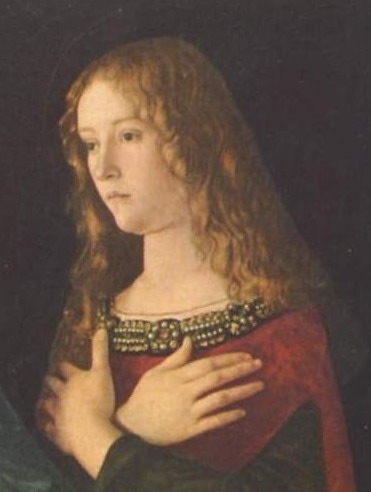
Giovanni_Bellini_Mary_Magdalene

Mary Magdalene by Giovanni Bellini

Who is who?

In this post we’ll take a look at each of the Marys in her particular context using the chart below.

Sorting Out the Marys of the New Testament

Mary Scriptural references    Biographical Notes
the mother of Jesus Matthew 1 & 2

Luke 1 & 2

John 2:1-11

Matthew 12:46

Mark 3:21, 31

John 19:25

Acts 1:14

  • A Jewish virgin betrothed to Joseph, the son of Heli.
  • Mary was from the small village of Nazareth.
  • Gabriel visited her with the news that she, a virgin, would conceive a Son Who would be named Jesus.
  • Mary’s cousin, Elizabeth, miraculously conceived in her old age, and bore a son, John the Baptist.
  • She witnessed her Son’s ministry, experienced at least one of His miracles, and was present at His crucifixion.
  • The last mention of Mary is found in Acts 1:14 where she is listed among the disciples gathered in an upper room before the momentous Day of Pentecost when the Holy Spirit was given.
Magdalene Matthew 27:55-56, 61

Matthew 28:1, 8-10

Mark 15:40, 47; 16:1, 9

Luke 8:2; 24:10

John 19:25; 20:1, 14-18

  • She was probably from the town of Magdala, about three miles north of Tiberias.
  • Jesus cast seven demons out of her.
  • She was among several women who traveled with Jesus and His disciples, providing for Him “out of their substance” (Luke 8:3).
  • Most agree that she is not to be identified as the sinful woman of Luke 7:36-40. (See the International Standard Bible Encyclopedia (ISBE), topic “Mary,” specifically “Mary Magdalene” as an example.)
  • She saw Jesus crucified; she stayed with the body until it was taken down, wrapped in linen cloth, and placed in the tomb.
  • She was among the women who brought spices to anoint Jesus’ body, and discovered that He had risen.
  • Mary Magdalene is specifically mentioned eleven times in the New Testament.
the mother of James the Less and Joses Matthew 27:56,61

Matthew 28:1

Mark 15:40, 47; 16:1

Luke 24:10

John 19:25

  • There is some interesting discussion among scholars concerning this woman. John 19:25 calls her Mary, the wife of Clopas (Cleophas), and mentions that she was Mary’s (the mother of Jesus) sister.
  • Unger’s Bible Dictionary (PC Study Bible edition) has the opinion that Mary of Clopas and Mary the mother of James and Less and Joseph (Joses) are the same person, and that she was the sister of Mary, the mother of Jesus.
  • As for sisters having the same name, Unger offers an explanation that on close examination of the Greek text, the virgin Mary’s name is Mariam; her sister’s name is Maria. (See topic Mary, sub-topic Mary Wife of Clopas.)
  • ISBE (PC Study Bible) comments that Clopas is also the Alphaeus mentioned in Matthew 10:3 as the father of James. Not all sources agree, however.
  • ISBE also suggests the possibility that this Mary was the older sister or half-sister of the virgin Mary.
the other Mary Matthew 28:1
  • She came to the tomb with Mary Magdalene.They encountered an angel who explained that Jesus had risen from the dead, and told them to bring the word to His disciples.
  • A commonly held opinion is that this Mary is the wife of Clopas, and mother of James the Less and Joses. There is some disagreement as to her identity.
of Bethany Matthew 26:7-13

Mark 14:3-9

Luke 10:38-42

John 11:1,5; 12:1-12

  • This Mary is the sister of Martha and Lazarus.
  • She is the one who anointed Jesus’ head with spikenard, foreshadowing His death and burial.
  • She is not the “sinner” who anointed Jesus’ feet in Luke 7:37.
  • She sat at Jesus’ feet for instruction in spiritual matters.
the mother of Mark Acts 12:12
  • The ISBE suggests this Mary was probably the aunt of Barnabas. It also comments that possibly she was “a wealthy widow of Jerusalem, who upon becoming a disciple of Christ, with her son, gave herself with whole-souled devotion to Christian service, making her large and well-appointed house a place of meeting for the proscribed and homeless Christian communion whose benefactor and patron she thus became” (PC Study Bible, ISBE, topic Mary, sub-topic “Mary, the Mother of John Mark”).
of Rome Romans 16:6
  • Paul mentions her as one who “labored much for us.”

Bread

The first Biblical reference to a woman doing specific work (other than childbirth) refers to a task done four thousand years ago. Abraham entertained unexpected guests, and Sarah made cakes for them.

So Abraham hurried into the tent to Sarah and said, “Quickly, make ready three measures of fine meal, knead it and make cakes.”

 Women made cakes from meal, or fine meal (flour), and “roasted the dough in the ashes” or “under the coals” or on hot stones.[1] The ancient people used four kinds of grain to make meal: millet, oats, barley and wheat. Sarah could have made cakes from any of the grains, although barley and wheat were preferred. Barley meal made healthful roasted flatbread and became a symbol of Israel’s strength.

“Nowhere—not even in Homer—is there written so forcible a tribute to barley as in the Book of Judges, where an Israelite dreams of a cake of barley bread tumbling into the Midianites’ camp and destroying all of Israel’s enemies.”[2]

Barley

Barley (Photo credit: freefotouk)

While barley, millet and oats make satisfying flatbreads, these grains have little or no gluten, which is necessary for making raised bread. Millet is gluten-free; oats contain a little gluten; and barley has less gluten than wheat. Because of its high gluten content, wheat flour makes exceptional raised bread. Kneading dough made from wheat flour develops strands of gluten. Gluten is stretchy and traps the gas generated during leavening. It enables bread to rise and hold its structure. Raised bread can be made with other grains if they are combined with wheat flour or another gluten source. Because of wheat’s baking qualities, it “became the king of grains—and remains so to this day.”[3]

Sarah’s Cakes

Did Sarah know how to make raised bread from air-borne yeast? She might have. Historians believe that Egyptians “invented” raised bread about 500 years before the time of Abraham.

Egyptian Bowl with Bread

Egyptian Bowl with Bread (Photo credit: feministjulie)

 “Around 2,500 B.C. the Egyptians learned how to exploit the gluten in wheat flour making the first raised breads from yeast. This discovery alone pushed wheat to the forefront ahead of the other prized grains of the day, oats, millet, rice and barley. The Egyptians grew huge amounts of wheat. They eventually started exporting wheat to other parts of the new world.”[4]

The Egyptians “made an enormous contribution to civilization” by setting aside their dough until it fermented, and “were known as the bread eaters…[because it was] the principal good of all Egyptians.”[5]

How the Egyptians first discovered the activity of invisible air-borne yeast is not known. Was an Egyptian woman called away from mixing her dough long enough that yeasts began to ferment it? When she returned and found a slightly bubbly mess, did she throw up her hands and say, “I’ll have to bake it anyway.” It’s lost to us.

Learned skill

 It is likely that the Israelites learned to make raised bread while they were slaves in Egypt. At the time of Moses, Egyptians already had brick ovens and were capable of making raised breads in various shapes, a skill attested to by Egyptian tomb paintings.  Earlier Hebrews, nomadic peoples like Abraham who lived in tents and followed their herds, “could not be bothered transporting such ovens through the land…either they parched the grain, like the reapers in the Book of Ruth, or they set flat cakes to bake” on a hearth or under coals.[6]

Adam Clarke states that Sarah made cakes on a hearth as was common among the Bedouin tribes. “When the hearth is strongly heated by the fired kindled on it, they remove the coals, sweep off the ashes, lay on the bread, and then cover it with hot cinders.”[7] Commentators John Gill and Jamieson, Fausset and Brown agree with Clarke that Sarah made cakes from sifted meal and cooked them on a hot surface under embers.

Time to Rise

It is stated on some Jewish websites that flour made from any of five basic grains (wheat, oats, rye, barley and spelt) and mixed with water begins to be leavened by natural yeasts in 18 minutes. Orthodox Jews, who seek to avoid any chance of dough beginning to ferment, bake their Passover matzohs quickly. Wild yeast will begin fermenting sugar when it settles on hydrated flour. But it takes more than 18 minutes of yeast activity to achieve dough sufficiently strong for baking a sizable raised loaf.

Peter Reinhart in The Baker’s Apprentice describes preparing an initial “seed culture” of wild yeast, flour and water over a period of one to four days. A small portion of this starter culture is mixed into a measure of flour and water to make a loaf of sourdough bread. After the dough is kneaded to develop gluten, it rests two to four hours as the yeast works. After resting, the dough is shaped and rises a final time before being baked.[8]

No Time to Rise

Ancient Israel had to leave Egypt quickly. After God administered the tenth plague, He wanted Israel out in a hurry. They couldn’t wait the hours to leaven, knead, shape, rise and bake their dough in Egyptian ovens. As stated in Exodus 12:33-34, the Israelites left with unused kneading bowls on their shoulders. Their daily bread was leavened but they didn’t have time to prepare it.

And the Egyptians urged the people, that they might send them out of the land in haste. For they said, “We shall all be dead.” So the people took their dough before it was leavened, having their kneading bowls bound up in their clothes on their shoulders.”

 A remarkable sign

Israel learned to make leavened bread in Egypt. Women baked it every day. It was a staple of their diet.

It was a remarkable sign for the Israelites to leave the land of “bread eaters,” the people who “invented” raised bread, who built brick ovens, who made fanciful shaped loaves, who baked bread for their gods and ancestors—to depart without any of the bread of Egypt.—Mary Hendren


[1] Six Thousand Years of Bread, H.E. Jacob, p.35.

[2] Same source, p. 15.

[3] Same source, p. 15.

[4] http://www.aaoobfoods.com, “Grain Information”

[5] Six Thousand Years of Bread History, pp. 26, 31

[6] Ibid, p. 35

[7] Adam Clarke’s Commentary, note on Gen.18:6, p. 42

[8] The Bread Baker’s Apprentice, Peter Reinhart, pp. 227-235