Author Archives: womenfromthebook

Here come the Royals: the house of Herod

Some of the most fascinating personalities in the Bible are members of a royal family or dynasty. The fact that there are 99 named kings and that the word “king” appears 2,256 times throughout its pages attests to the importance of such an imperial designation. References to queens are not so plentiful—that term is mentioned only 54 times, most of which have to do with Queen Esther or Queen Vashti.

The reason for this disparity is because kings governed Israel and Judah almost entirely. Only Athaliah is listed as a ruling queen in Israel, a position she murderously usurped, as we discovered last week when discussing Johosheba.

The genealogy of the kings of Israel and Judah...

The genealogy of the kings of Israel and Judah. Based on a literal interpretation of 1 and 2 Kings. Note: In the kings of Israel, a horizontal arrow can indicate a change of dynasty (lack of known genealogical connection). (Photo credit: Wikipedia)

Keeping it all straight

Sometimes it is difficult to keep the line of kingly succession straight because of a duplication of names, or the use of alternate (aka) names. This presents a challenge when trying to follow the chronologies of the kings of Israel and Judah. For example, in 2 Kings 8:25, Jehoram (Joram), king of Judah, reigns at the same time as Joram (Jehoram) king of Israel. Careful reading and sometimes even charting and note taking are necessary to keep on track.

This also holds true in the New Testament. Seven Herods[1] reigned just before and during the first century. Herod the Great, the patriarch of the Herodian dynasty, is the infamous king responsible for the “slaughter of the innocents” (Matthew 2:16). He died in 4 B.C. Herod Agrippa 2 was the last of his line.

Terms of administration

  • Caesar: title given to a Roman emperor
  • Governor: chiefly refers to officers of the Roman imperial administration (Matthew 10:18; 2 Cor. 11:32)
  • King: one who governed a specific territory under the rule of the Roman Caesar
  • Procurator: In ancient Rome, this was an administrative official with legal or fiscal powers. Examples are Pilate, Felix and Festus.
  • Queen: In the context of the tribes of Israel, a term “queen” might refer to the queen mother—that is, the mother of the king. She potentially had a great deal of influence over the internal affairs of the palace, as in the case of Bathsheba, but not as the acting ruler of a nation. Often the designation is generic, signifying a woman married to a king. Two non-Israelite queens mentioned in the Bible apparently enjoyed administrative powers of position and wealth: the Queen of Sheba (1 Kings 10), and Candace, the title of the queens of Ethiopia (Acts 8:27-28).
  • Tetrarch: Gospel accounts sometimes reference the name of a specific Herod with the designation of tetrarch: “At the time Herod the tetrarch heard the report about Jesus…” (Matthew 14:1). A tetrarch signifies a prince who governs one-fourth of a domain or kingdom (International Standard Bible Encyclopedia, topic “Tetrarch”).

Coming attractions

With all this as a backdrop, the next posts will examine the intrigue surrounding the lives of several notorious royals: Drusilla, Bernice, and the ever-intriguing and controversial Salome.


[1] The rest of his dynasty is as follows:

  • Herod Philip 1 (or simply, Philip), son of Herod the Great and his third wife, Mariamne 2, daughter of Simon the high priest (Matthew 14:3)
  • Herod Archelaus, son of Herod the Great and his fourth wife, Malthace, a Samaritan (Matthew 2:22)
  • Herod Antipas, brother of Archelaus. Married Herodias, wife of brother, Herod Philip 1.
  • Herod Philip 2 (also called Philip the Tetrarch), son of Herod the Great through his fifth wife, Cleopatra of Jerusalem. He married his niece Salome, daughter of his half-brother Herod Philip 1 and Herodias.
  • Herod Agrippa 1, son of Aristobulus, son of Herod the Great by Mariamne 1
  • Herod Agrippa 2, son of Agrippa 1

Next week: here come the Royals

The British royal family on Buckingham Palace ...

The British royal family on Buckingham Palace balcony after Prince William and Kate Middleton were married. (Photo credit: Wikipedia)

This week the media is abuzz with the announcement of the birth of a new royal in the offing:

LONDON (Reuters) – Britain’s Prince William and his wife Catherine are expecting a baby, destined to be the country’s future monarch, although the mother-to-be is in hospital with a type of very acute morning sickness that sometimes indicates twins.

“Their Royal Highnesses The Duke and Duchess of Cambridge are very pleased to announce that The Duchess of Cambridge is expecting a baby,” the prince’s office said in a statement on Monday, adding that Queen Elizabeth and the royal family were delighted.

Nothing seems to catch the attention of the world at large like the life of royalty, especially the British monarchy. The Bible has its share of royals, and next week we’ll take a look at individuals among the more famous…or infamous, and some who barely merit a sentence in the whole context of their times.

Thanks for dropping by. This journey is so much nicer in the company of friends

Courage: also known as

Recap

So far, we’ve seen courage exhibited as the nerve to step forward, or the determination to go back. Each decision was fraught with its own unique “what-if”—what if Naaman was outraged at the thought of consulting the spokesman for the God of Israel, and took it out on the little maid? She would be defenseless. Or, what if Naomi met hostility and harsh judgment for having gone to Moab in the first place, much less for staying on indefinitely? Then what would she do?

Both embarked on a course of action, willing to meet the resulting consequences—unintended or otherwise. Their stories ended on a positive note.

In other words

I thought it might be interesting to explore more characteristics of courage as manifested in the lives of several other women from the Book. The broad definition of courage appears simple and concise, i.e., boldness or braveness, but its nuances reveal many fascinating, complex facets.

For this post, we will consider a list of its synonyms, and then revisit some Bible accounts of this attribute at work in its various forms.

First the synonyms…

adventurousness

audacity

backbone

bravery

courageousness

daring

dash

dauntlessness

endurance

fearlessness

gallantry

gameness

gutsiness

grit

heart

heroism

intestinal fortitude

intrepidity

nerve

pluck

prowess

rashness

spirit

spunk

stoutness

tenacity

valor

virtue

Meet the women: courage at work

English: Jael Smote Sisera, and Slew Him, circ...

English: Jael Smote Sisera, and Slew Him, circa 1896-1902, by James Jacques Joseph Tissot (French, 1836-1902) or follower, gouache on board, 5 7/16 x 7 3/8 in. (13.9 x 18.8 cm), at the Jewish Museum, New York (Photo credit: Wikipedia)

  • Jael (Judges 4:17-23):  the Kenite woman who killed Sisera, Israel’s formidable enemy during the time of Deborah. Jael witnessed a man running towards her from some unseen threat. She recognized him as Sisera, and instantly knew his problem: Barak and ten thousand of his men were in hot pursuit. Always resourceful, she invited him into her tent, implying sanctuary. With customary hospitality, she gave him a drink of fermented milk, lulling him into a false sense of security and eventually, sleep. Jael, with quiet deliberation, picked up a hammer and proceeded to drive a tent peg through his temple, thus fulfilling Deborah’s prophecy: “…for the Lord shall sell Sisera into the hand of a woman” (vs. 9).
  • Jehosheba (2 Kings 11:2; 2 Chron. 22:11):  the half-sister of King Ahaziah who saved her nephew from assassination. After Ahaziah died in battle, his mother, Athaliah, attempted to kill all her grandsons while usurping the throne. Spurred by the horror of impending disaster, Jehosheba rescued Ahaziah’s youngest son, the infant Joash. With the help of her husband, the righteous priest Jehoiadah, she hid the boy in the Temple for six years until he was old enough to be proclaimed the rightful king. Jehosheba’s act preserved “the house and lineage of David” (Luke 2:4), from which Jesus was descended.
  • Jochebed (Ex. 2:1-4): the mother of Moses who devised a plan to save him from the Pharaoh’s death decree targeting all Hebrew baby boys. After three months, she knew she could no longer safely hide Moses herself. So she secreted her infant among the reeds along the riverbank, and stationed his older sister Miriam to stand vigil. Jochebed’s valiant efforts to spare her child succeeded, and she possibly lived to see Moses become the revered leader and liberator of the people of Israel.
  • Michal (1 Sam. 19:10-17): king Saul’s younger daughter, and David’s wife. Michal learned of her father’s demented intention to kill her husband, and her only thought was to save her beloved. She helped David escape through a window, and used her quick-thinking to devise a plan. Through subterfuge, she deceived her father (a risky activity given Saul’s often unstable state of mind), and assured her husband’s getaway.
  • Rahab (Joshua 2:1-6): the harlot who secretly housed two men sent by Joshua to scout out Jericho, and helped them avoid apprehension. First, she hid them in stalks of flax on her roof; and then, after sending the king’s messengers on a false trail, Rahab let the spies down the outside wall by a rope through the window of her house.

    Judah and Tamar (painting circa 1650–1660 by t...

    Judah and Tamar (painting circa 1650–1660 by the school of Rembrandt) (Photo credit: Wikipedia)

  • Tamar (Gen. 38:6-30): the widow of Er, the wicked firstborn son of Judah who was slain by the Lord. According to the law of levirate marriage, Judah’s second son, Onan, should have married Tamar. Their first child would have been regarded as his brother’s, and carried on his name. However, Onan refused to comply, and Judah encouraged Tamar to wait for his third son, Shuah, to reach maturity. Time passed. Shuah grew to manhood, but no marriage union was forthcoming. Undaunted, Tamar devised a plan. She tricked Judah himself into having sex with her in order to produce offspring, and secure her family’s rights of inheritance as part of Judah’s posterity.
  • Servant girl of En-rogel (2 Sam. 17:17): the girl who carried military intelligence obtained by Hushai, David’s spy, when Absalom’s revolt forced David to flee Jerusalem. It is possible that females of her status (she may have worked in the temple complex or for a wealthy loyalist) had freedom of movement in and out of Jerusalem, thereby allowing her to go unnoticed as she went about her covert activities.

The courage to go home

Naomi faced a decision. Should she stay in Moab or return to Bethlehem? It wasn’t clear. It was uncertain either way. And what she did would affect her daughters-in-law, too. With Elimelech and her sons gone, Ruth and Orpah were her family. She loved them and they loved her. If she stayed in Moab, could they find some way of looking after one another?

To remain in Moab would be difficult because they were all widows with no means of support. To be a widow without support in the ancient Middle East was a hardship, even in one’s own country. Her only sons, Mahlon and Chilion, who would have supported her, were dead. It was even more desperate to be a widow outside one’s country. She was an Israelite widow in Moab without family support. It was ominous.[1]

Logically it would be better for Ruth and Orpah to stay in Moab. When each woman returned to her father’s house she would have the help of her family. Ruth and Orpah were young. Their kinfolk would help them find husbands. They would have a better chance for happiness and security in their own country than in Israel.

But how could they separate from one another? Would she be a hindrance to them in Moab? Would a Moabite man want a wife encumbered with an Israelite mother-in-law?

Going home was fearful. She had been gone ten years. She would go back destitute with no prospects for the future.

Naomi and Elimelech had left home for a while because of a famine (Ruth 1:1). They didn’t intend to stay away, but when the famine was over, they didn’t go back. They stayed in Moab—in a “land of idolaters.”[2]

Although Bethlehem was only a short distance to Moab—thirty miles—Naomi came to see it as a long way from God. She came to believe that the deaths of her husband and sons were punishment. She had deserted her homeland and the God of her fathers.[3] She resented how things had gone in her life. “Call me Mara, because the Almighty has made my life very bitter. I went away full, but the LORD has brought me back empty. Why call me Naomi? The LORD has afflicted me; the Almighty has brought misfortune upon me” (Ruth 1:20-21).

Naomi entreating Ruth and Orpah to return to t...

Naomi entreating Ruth and Orpah to return to the land of Moab by William Blake, 1795 (Photo credit: Wikipedia)

When she made the decision to go home, Naomi asked Orpah and Ruth to return to Moab and not continue on to Israel. She appealed to their common sense. A law in Israel allowed a childless widow to marry another son in the family of the deceased husband (Deut.25:5-10). Under that law, Ruth and Orpah would be entitled to marry any other sons in Naomi’s family. “I have no more sons for you,” she said. And even if she could remarry and have sons right away, should Ruth and Orpah wait around for them when there were eligible men in Moab now? Customarily when a young widow returned home, “preparations for another marriage [were] initiated,”[4] so it would be easier for them to find husbands in their own land.

After advising Ruth and Orpah, Naomi asked God to bless them. “May the LORD show kindness to you, as you have shown to your dead and to me. May the LORD grant that each of you will find rest in the home of another husband” (Ruth 1:8-9).

Nothing more is said about Orpah and how the blessing was fulfilled in her life. Scripture follows Ruth into Israel and recounts the favor shown her by an honorable man for “what you have done for your mother-in-law since the death of your husband—how you left your father and mother and your homeland and came to live with a people you did not know before” (Ruth 2:11). Ruth was additionally blessed with an advantageous marriage. She and Boaz were blessed with the birth a son named Obed.

Not all courageous decisions end well, but Naomi’s did. Her difficult homecoming began a chain of events that brought blessings to generations of people through the lineage of her grandson (Ruth 4:18-22).

For Naomi personally, the village women rejoiced, “He will renew your life and sustain you in your old age. For your daughter-in-law, who loves you and who is better to you than seven sons, has given him birth” (Ruth 4:15).

Then she took Obed into her arms.—Mary Hendren


[1] The Expositor’s Bible Commentary, Vol. 3, p.520, note on Ruth 1:4

[2] All the Women of the Bible, Herbert Lockyer, p.117

[3] Ibid, p. 117.

[4] The Expositor’s Bible Commentary, Vol. 3, p. 521

The many faces of courage

The word courage usually brings to mind visions of Daniel in the lion’s den, David facing the giant Goliath, Elijah confronting the priests of Baal, or perhaps Deborah[1] and Barak—all legendary heroes who fought against formidable odds, or took a stand against evil. There are, however, other kinds of courage manifested in the actions of ordinary individuals, who in times of personal crises, exhibit pluck, daring, and sometimes, momentary bravery.

Poesy learns to climb the stairs, poolside, Ho...

Poesy learns to climb the stairs, poolside, Hotel Zaza, Houston, TX, USA 3.JPG (Photo credit: gruntzooki)

This attribute is no respecter of persons: it’s found in young and old, privileged and poor, sinner and saint. In thinking about the topic and considering various Bible examples, I noted a common thread: the courageous person leaves a comfort zone to make difficult decisions, and then is compelled to follow through with actions having known or unknown consequences.

For instance, consider Paul, who after having so violently persecuted the church, repented, and then humbly but resolutely faced the very group he had savaged. He served them until his dying day, and there undoubtedly were those who never forgot his hurtful deeds.

Hebrews 11:35-38 speaks of that great anonymous group of believers who endured incredible suffering, and bravely held on, faithful, unflagging in their zeal–of whom, the scripture says, “… the world was not worthy….” (vs 38).

In this week’s posts we’ll be visiting the lives of some noteworthy women and an exceptional young girl, all of whom faced difficult challenges and risks. Through some inner strength we call courage, they were able to prevail.


[1] For a fascinating account about Deborah, please see http://lifehopeandtruth.com/change/faith/women-of-faith/deborah/

Blessings

As I mentioned in a past post, next week is Thanksgiving here in America. Traditionally it is a day for friends and family to gather from near and far, enjoy a meal, and pause to reflect on the many blessings of the past year. Mine are too many to count, but among them, I’m grateful for the internet which makes this blog possible. And for all of you who have joined Mary and me on our journey of discovery.

English: The story of a thanksgiving day, as i...

English: The story of a thanksgiving day, as in the offering of first fruits in Deuteronomy 26:1-11, illustration from a Bible card published by the Providence Lithograph Company between 1896 and 1913 (Photo credit: Wikipedia)

The Bible is such an incredible book: It never grows old; its treasures are never fully mined; its personalities so intriguing; its wisdom profound. The potential contained between its covers gives me hope in a sick and troubled world. I am so thankful for it, and for the One Who graciously inspired it.

***

There will be no new posts until December 10 when we will take a look at some amazing women of courage.

May God’s richest blessings be showered upon us all in the coming year.

Hannah’s Song

Prelude

Hannah’s story is a tale of good and evil. For thousands of years it has appealed to our desire for fairness, for good to be rewarded and evil punished.  The story occurs at a bad time in Israel’s history, and it begins with conflict. The author skillfully described the characters—a suffering wife, a jealous rival, an appeasing husband, a failing priest and his reckless sons.

A key factor in the story is Hannah’s inability to have children. It was a shameful condition—she couldn’t produce an heir. As a consequence, her husband took a second wife. Adding to Hannah’s despair was the belief that God closed wombs as punishment for something sinful.

To be barren “was more than a physical or social problem. Deep religious meanings were attached…whether temporary or permanent, barrenness was thought to be the curse of God. It is hard for us to imagine how devastating these events would have been for the childless wife. She was spiritually ruined, socially disgraced, and psychologically depressed. She was married to a husband who wanted a child to assure the continuation of his family line. That husband might continue to love her, but she felt that was small consolation.”[1]

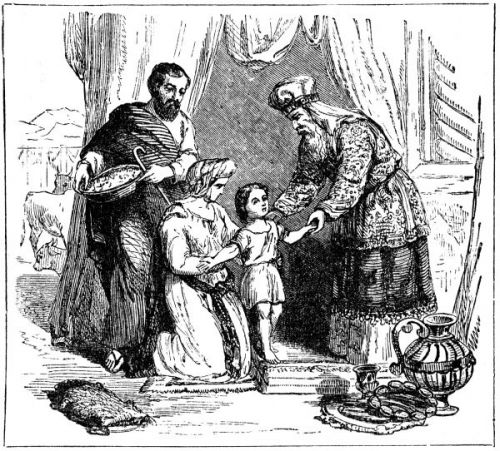
But God reversed things. He answered Hannah’s prayer for a son. In time she returned him to the LORD’s service in the temple. At the time of Samuel’s presentation to the high priest, Hannah stated, “I am the woman who prayed for this child, and the LORD has granted me what I asked of him. So now I give him to the LORD. For his whole life he will be given over to the LORD” (I Samuel 1:27-28).

Hannah’s song of praise

For the occasion she composed a poem (song, prayer, ode) of praise. Whether she sang the words or recited them is not known. But I picture her confident, composed, reverent and buoyed in spirit as she presented Samuel to One who would “guard the feet of his saints” and dedicated him to One who owns “the foundations of the earth” (I Samuel 2:8-9).

Hannah’s hymn is a classic praise song, and scholars have written extensively about it. My observations barely touch the surface. I see in Hannah’s praise/song four truths about God:

  • He is the Source of joy.
  • He is holy.
  • He corrects injustice.
  • He satisfies hunger.

God is the Source of joy

Hannah attributed her joy to the LORD. Essentially it flowed from His greatness. Samuel was a joy. Motherhood was a joy. Her improved status was a joy. But God was first in her heart—before husband, children and circumstances. Her praise/song begins where joy begins.

Hannah:  My heart rejoices in the LORD; my horn is exalted in the LORD. I smile at my enemies, because I rejoice in Your salvation.

God is Holy

During the period of the Judges, Israel had fallen away from God. Without godly leadership, “everyone did what was right in his own eyes” (Judges 21:25). Even Hannah’s marriage with the husband she loved was an arrangement that seemed the right way to “get children.” Polygamous marriages violate God’s pattern of “holy” matrimony (Genesis 2:24-25).

That God is “holy” means He is morally perfect and absolutely separated from evil.[2] Hannah’s world was enmeshed in evil. Nothing was perfect and sinless. Nothing on earth was like God.

No one is holy like the LORD, for there is none besides You, nor is there any rock like our God.

God corrects injustice

Even the temple was corrupt. Eli did not deal with his wicked sons. They slept with women in the temple and commandeered food from the altar. People in Shiloh for the holy days came to temple in a drunken state. Eli lost a sense of proportion. He made unjust accusations. The sins of the priests in particular were “very great in the LORD’s sight” (I Samuel 2:17).

In her hymn Hannah praises God for setting things right between strong and weak, rich and poor. He brings down the mighty and lifts the fallen. She prophesied that God would give power to His king, His anointed, the Messiah.

The bows of the mighty men are broken, and those who stumbled are girded with strength…He raises the poor from the dust and lifts the beggar from the ash heap, to set them among princes and make them inherit the throne of glory…He will guard the feet of his saints, but the wicked shall be silent in darkness…the LORD will judge the ends of the earth. He will give strength to His King, and exalt the horn of His anointed.

God satisfies hunger

Famine and hunger are mentioned over ninety times in the Old Testament. Hannah’s story does not mention a famine, but she would have been familiar with Israel’s droughts and weather-related history.  She would have known about the famine in Joseph’s day and Egyptians indenturing themselves for food.

She praises God for ending physical hunger and satisfying the longings for children, judgment and strength.

Those who have hired themselves out for bread, and the hungry have ceased to hunger. Even the barren has borne seven…The LORD will judge the ends of the earth.

Living her song

In what we know of the rest of her life, Hannah lives her song. She was blessed with three more sons and two daughters. She saw her son become a righteous judge in Israel. In her lifetime Eli died and his sons were slain. ♦ Mary Hendren


[1] “Birth and Infancy, The Childless Couple,” Illustrated Manners and Customs of the Bible

[2] Mounce’s Complete Expository Dictionary of Old and New Testament Words, pp. 337-338

Mary’s Song

The announcement

“Now in the sixth month the angel Gabriel was sent by God to a city of Galilee named Nazareth, to a virgin betrothed to a man whose name was Joseph, of the house of David. The virgin’s name was Mary. And having come in, the angel said to her,”Rejoice, highly favored one, the Lord is with you; blessed are you among women!” But when she saw him, she was troubled at his saying, and considered what manner of greeting this was. Then the angel said to her, “Do not be afraid, Mary, for you have found favor with God. And behold, you will conceive in your womb and bring forth a Son, and shall call His name JESUS. He will be great, and will be called the Son of the Highest; and the Lord God will give Him the throne of His father David. And He will reign over the house of Jacob forever, and of His kingdom there will be no end.” (Luke 1:26-33)

The words of Gabriel filled her with awe, some fear, and wonderment. She, a virgin, would conceive and bear “the Son of the Highest!” Still, bolstered by her faith and trust, she managed to answer, “Behold the maidservant of the Lord! Let it be to me according to your word” (verse 38).

John MacArthur, in his book, Twelve Extraordinary Women (2005), wrote, “There’s no evidence that Mary ever brooded over the effects her pregnancy would have on her reputation. She instantly, humbly, and joyfully submitted to God’s will without further doubt or question. …Her great joy over the Lord’s plan for her would soon be very evident” (page 114).

Miracle and blessing x two

Mary was not the only one touched by a miracle. Her relative, Elizabeth (whom some say could have been in her eighties), would also bear a son—this after having endured a lifetime of barrenness. These two, John and Jesus, would work in tandem, each fulfilling his awesome part of God’s unfolding plan.

Mary’s heart song

Her heart full of awe and reverence, Mary rejoiced with what is now known as “the song of Mary,” or her “song of thanksgiving.”[1]Perhaps its inspiration came to her as she walked from Nazareth to south of Jerusalem where Zacharias and Elizabeth lived. The long walk allowed plenty of time for pondering the angel’s words.

view of Nazareth

view of Nazareth (Photo credit: Wikipedia)

Not capable?

Some may wonder if a young unschooled girl was capable of composing such a magnificent song. It reflected knowledge of scripture and Old Testament concepts and phrases,[2] but she had not attended a synagogue school—that was reserved for boys. She must have learned it at home.

Jewish parents strove to provide a “well-rounded education” for their daughters and sons. Synagogue school for boys supplemented what was taught to all children at home: practical skills and “wisdom centered around one’s relationship with God.”[3] The major concern of Jewish parents was that their children come to “know the living God.”[4]

“Familiarity with the OT was not at that time so unusual for a pious Jewess like Mary as to bar her from consideration as its author. Moreover, it reflects qualities suitable to the mother of the Lord” ( Expositor’s Commentary, Vol. 8, page 835). This commentary notes the “ability of people in ancient times to absorb and remember the spoken word, especially the biblical word.”

It is likely that Mary and her siblings had a strong foundation in the Old Testament scriptures and an understanding of their relationship to God.

Offering praise

My soul magnifies the Lord, and my spirit has rejoiced in God my Savior.

 Mary began by magnifying God.  “The verb megalunein…signifies ‘to celebrate with words, to extol with praises.’This is the only way in which God can be magnified, or made great; for, strictly speaking, nothing can be added to God, for he is infinite and eternal; therefore the way to magnify him is to show forth and celebrate those acts in which he has manifested his greatness.”[5]

Mary offered humble reverence:

For He has regarded the lowly state of His maidservant; for behold, henceforth all generations will call me blessed. For He who is mighty has done great things for me, and Holy is His name (verse 48).

 Highly favored

God favored her with a unique role in human history. She would be remembered for it. Things would never be the same after that. Some commentators state that Mary’s praise of God’s power in verses 51-53 refers to the past and the future. “These verses portray a ‘reversal’ in the end times, when those who have abused power will be judged and those who have suffered persecution will be exalted. Mary was looking forward to the day when God’s people are no longer oppressed, but are instead blessed by the Lord. God’s strength with His arm figuratively describes His activity and power as Savior of His people.”[6]

Mary understood her role in the promises God made to Abraham:

He has helped His servant Israel, in remembrance of His mercy, as He spoke to our fathers, to Abraham and to his seed forever (verses 54-55).

 Happily blessed

The word “blessed,” from the Greek makarios, conveys being especially favored, happy and privileged. Gabriel stated that Mary was blessed among women (Luke 1:28). Three times Elizabeth used the word “blessed”: blessed among women, blessed the fruit in her womb, blessed in believing (verses 42-45). Mary recognized she would be remembered as a woman “blessed.”

Undoubtedly, she enjoyed many happy hours with her baby. She may have been an especially joyful and grateful mother. Her natural love for the infant Jesus was enriched by God’s love for His Son through her. What a pleasure it must have been to hold her child, to look in his eyes, to see his first steps.

However, the state of being blessed referred to by Gabriel, Elizabeth and Mary herself related to her privilege of bearing “the Son of the Highest,” the “Son of God” (verses 32, 35), and not necessarily to her happiness.

Why a “song”?

Sometimes the use of certain words leads to questionable impressions. For instance, translators have labeled Mary’s exaltation as a “song.”[7] And indeed through the ages her words have been incorporated into hundreds of musical compositions in various forms; they figure prominently in the liturgy of various denominations even today. These hymns or “canticles” can be sung or spoken,  and customarily have musical accompaniment.

Did Mary set out to compose a song with future use or presentation in mind? The Bible account does not give that indication. Rather it would seem her words were a spontaneous outpouring of a deep devotion to God–a prayer, if you will–which somehow Luke was able to quote in his Gospel account.

Upon reflection

I believe Mary composed the song herself, that her parents instructed her in the ways of God, that she loved the scriptures. To me, her betrothal signifies a sound-minded, realistic appreciation for marriage and family. Because her song touches on prophetic themes, I believe God inspired her words.—Mary Hendren (with Karen Meeker)


[1] Luke 1:46-55

[2] Expositor’s Bible Commentary, Vol. 8, note on Mary’s song, p. 835.

[3] “Childhood and Adolescence,” Illustrated Manners and Customs of the Bible, p. 452.

[4] Ibid, p. 453.

[5] Adam Clarke Commentary, note on Luke 1:46, Online Bible.

[6] NKJV Study Bible, Second Edition, note on Luke 1:50-53.

[7] Did you ever wonder where the chapter and section headings found in Bible translations came from? “With the exception of the titles in Psalms, the Bible’s authors didn’t write their books of Bible with chapter or section headings in mind. They were added later by translators in order to help organize and divide the Bible into easier to digest pieces.

You’ll note headings in most English translations of the Bible, though they do vary across different translations. For example: Genesis 1 begins with the heading: “The beginning” in the New International Version 1984 translation, “The Account of Creation” in the New Living Translation, and there’s no header at all in the King James Version. A side by side comparison of Genesis 1 in five translations easily highlights the differences in section headings.” http://www.biblegateway.com/blog/2012/01/section-headings-in-the-bible/

Songs of the heart

The Woman’s Study Bible lists ten instances of hymns or songs that are associated, loosely or directly, with women. It is an interesting list including the individual songs of Miriam, Deborah, and Mary, and generic references to anonymous people, as in II Samuel 19:35: “Can I hear any longer the voice of singing men and singing women?”

In all instances cited, the accompanying descriptions indicate times of celebration, worship, and praise (see topic “Hymns and Songs Associated with Women”).

The most well-known songs are contained in “The Book of Psalms.” It is a collection of 150 compositions written by various people (but principally David)  to be performed in some way. The very term “psalm” comes from a Latin term, Liber Psalmorum, derived from the Greek word for “a song sung to a stringed instrument,” (Songs of the Heart, Nahum M. Sarna,1993, page 10). Both men and women singers lifted their voices in praise, or sometimes lamentation, to the great God of Israel. These have inspired many beloved hymns sung in worship services today.

In the next posts we will be looking at two other songs—the songs of Mary and Hannah. Each has a central inspiration. By direct miracle, they were promised sons—sons destined to be used mightily by the God Who gave them.

Next week: hymns and songs of praise

My thoughts have definitely turned to Thanksgiving, now just days away here in America. The best part for me is always family, especially the times when we have  rehearsed our individual blessings and thanksgiving as we go around the table. It is humbling to hear what God has done or made available in each of our lives.

Thanksgiving oven

Thanksgiving oven (Photo credit: Wikipedia)

Of course, most Thanksgivings also revolve around food—turkey, dressing and all the trimmings. This year my thoughts have not only been on family and meal-planning, but on freedom, and God’s graciousness—His endless gifts of blessings and plenty.

Sometimes I find it difficult to put into words how thankful I am, properly acknowledging God as the Great Giver He is. Gifted people over the ages poured out appreciation and exaltation in words and melodies that touch the heart. Others chose poetry and prose. Next week we’ll revisit two songs, prayers really, offering praise with such eloquence that they have resonated over thousands of years—the songs of Hannah and Mary.