Category Archives: Uncategorized

Coming next week….

This week we touched on the topic of Bible women in the workplace, profiling two in the New Testament. One of the challenges in looking back to ancient times is scanty physical evidence or few existing records. Because of that, curious students of the Bible often must look at the cultural norms surrounding a particular woman, read accounts written by people of the time (the works of Josephus, for instance) and then, if you will, “tease out” a perception of what she might have been like, or how she might have interacted in her community. I believe Mary Hendren’s post, “Purple,” is an excellent example of this process at work.

Next week: sickness and health

It is obvious when reading the Gospels that Christ spent much of his ministry healing the sick. Sickness and suffering was (and is) a fact of life, and every generation has to deal with that reality—especially women who generally are the caregivers. Join us for a glimpse of the health challenges and environmental conditions facing people in first-century Palestine.

Stamp for marking semi-solid sticks of eye oin...

Stamp for marking semi-solid sticks of eye ointments (collyria) before they harden, inscribed with four remedies prepared with saffron by a Junius Taurus from a prescription of a Pacius. Stone, 1st-3rd centuries AD. Said to be from Naix, northern France. (Photo credit: Wikipedia)

Until then, thanks for joining us on this journey of discovery!

Purple

And on the Sabbath day we went out of the city to the riverside, where prayer was customarily made; and we sat down and spoke to the women who met there.

 Now a certain woman named Lydia heard us. She was a seller of purple from the city of Thyatira, who worshiped God. The Lord opened her heart to heed the things spoken by Paul. And when she and her household were baptized, she begged us, saying, “If you have judged me to be faithful to the Lord, come to my house and stay.” So she persuaded us. (Acts 16:13-15)

In one paragraph, Luke introduces Lydia, the first lady converted through Paul’s preaching in Philippi. Lydia owned a business and a home. She hosted Paul and his companions while they were in Philippi. Scholars have studied her name, her business, and her role in the church at Philippi to enhance Luke’s description.

Person or place?

Commentators say the lady’s proper name may not have been Lydia. She may have been known as the Lydian woman because she came from the region of Lydia in Asia Minor. Although Lydia might have been her proper name, “it seems more likely that it merely means ‘the Lydian,’ and that it was the designation by which she was originally known in Philippi.” [1] Some commentators propose that the lady was actually either Euodia or Syntyche referred to in Phil.4:2.[2]  Luke identified her as Lydia, a common name for women in Phoenicia at one time, and mentioned no other name for her.

Her heritage

Was she a Jew? Based on the words that she was “a worshiper of God,” scholars believe Lydia was not a Jew by birth but was a Jewish proselyte.[3]  Lydia kept the Sabbath. She was among the women who assembled by the riverside and heard Paul preach about Jesus Christ.

Her trade

What did it mean to be a “seller of purple”? Did she sell dye? Purple cloth? Purple garments? Scholars say she could have sold any of these items or a combination of them all and be considered a “seller of purple.” One source suggests she sold cloth and garments of deep turkey red, commonly made in her hometown of Thyatira.

From snails to dye

Spiny dye-murex used to make purple in Pliny's day

Spiny dye-murex used to make purple in Pliny’s day (Photo credit: Wikipedia)

The remarkable Tyrian purple was made from a secretion of the predatory sea snail, Murex brandaris. Murex snails flourished in the eastern Mediterranean along the coast of Phoenicia. The Tyrians learned a “secret method of extracting the glandular substance from which dye was produced.” The Roman writer Vitruvius stated that Tyrian “purple exceeds all colors in costliness and superiority of its delightful effect.”[4] Because thousands of snails were crushed to produce a small amount of dye, it was expensive. Until the Murex snails were over-harvested, the wealth of Tyre was based primarily on the manufacture of dye and trade in purple cloth.

Commercial centers

Tyre operated a famous dye-works. Purple silk from Tyre was the finest fabric available. Wearing Tyrian purple garments—silk, cotton, or wool—symbolized power. “There was great demand for this fabric as it was used on the official toga at Rome and in Roman colonies.”[5]

Thyatira, a city in the region of Lydia, also operated a dye-works, and it was famous for the color red. Dyers in Thyatira used a red vegetable dye made from madder root. “The waters of Thyatira are said to be so well adapted to dyeing that in no place can the scarlet cloth of which fezes are made be so brilliantly or so permanently dyed as here.”[6] The dyers developed a process involving “sumac and oak galls, calf’s blood, sheep’s dung, oil, soda, alum and a solution of tin” (“Rubia,” Wikipedia). In time the Lydian guilds produced purple cloth that competed with the fabric of Tyre. It was said that the Lydians were “celebrated for their dyeing, in which they inherited the reputation of the Tyrians.”[7]

To summarize, scholars suggest Lydia (the Lydian lady) sold purple fabric that was woven and dyed in Thyatira, from dye manufactured in Tyre.

What do I believe?

I believe Lydia was a wise and influential person. I think she had good business sense and an eye for quality. I imagine she traveled to Tyre and Thyatira on buying trips and related interesting travel stories. I picture her as competent in what she undertook, thorough in following procedures, and a good negotiator.

I believe God is amazing. He created a unique snail which supplied a gorgeous purple that would clothe the mighty (Revelation 17:4) and would figure in the rise and fall of a great empire (Ezekiel 27:7; Isaiah 23:8). He arranged for a seller of that purple to hear Paul preach on the Sabbath. He opened her mind and the minds of those in her household. With them He began the Church of God in Philippi.  ♦ Mary Hendren


[1] “Lydia,” The Hastings’ Dictionary of the Bible

[2] “The conversion of Lydia,” The Expositor’s Bible Commentary

[3] “Lydia,” The New Unger’s Bible Dictionary

[4] “Hexaplex trunculus,” Wikipedia

[5] “Note, Acts 16:14,” Robertson Word Pictures, on-line

[6] “Thyatira,” The New Unger’s Bible Dictionary

[7] “Note on Acts 16:14,” JFB on-line

P & A Tent Makers

The Jews in Rome were fighting with one another about the person of Jesus Christ. Was He the Messiah, or was He not? To end this religious disturbance, Emperor Claudius issued an edict expelling all Jews from Rome.  “As the Jews were indulging in constant riots at the instigation of Chrestus, he [Claudius] banished them from Rome” (Expositor’s Bible Commentary, Vol. 9, 1981 Edition, p. 481).  Priscilla and Aquila, Jewish Christians, packed up their business and moved to Corinth.

It is fortunate that their tent making business was portable and could be set up in elsewhere. Tent making at that time was a respected and profitable business. Priscilla and Aquila appear to have been joint owners of the business, and it is likely they set up shop in central Corinth.

How large was their shop? Historians say that prosperous tent makers hired subcontractors: weavers, leather workers and assemblers. After a time in Corinth, their shop probably expanded and employed a number of workers. Expositor’s Commentary states that Priscilla and Aquila “owned a tent making and leather-working firm, with branches in Rome, Corinth, and Ephesus” (Expositor’s Bible Commentary, 1981 Edition, Vol. 9, p. 481).

What kind of tents did they make? Several kinds of tents were commonly made at the time: black goat hair tents, small leather tents for soldiers, woven linen canopies for shade, and umbrellas. Consistently the commentaries mention goat hair tents, and if their tent making business produced goat hair tents along with leather/skin tents, they would have employed leather workers, spinners, weavers, and those skilled at sewing woven panels into tents.
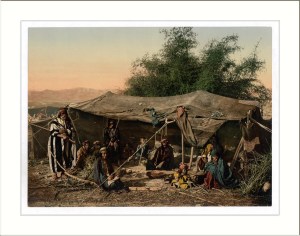
Goat hair tents are still manufactured today (“The Goat Hair Tent”). Commentators state that the skills required to make today’s woven tents are the methods that have been passed on from craftsmen in ancient times.

However, the kind of tents manufactured by the business is not what’s really important in their story. The tent making profession linked Priscilla and Aquila with the apostle Paul and opened for them a remarkable interval of Christian service. Paul met them when he applied to work as a journeyman tentmaker in their shop. He came to Corinth on a missionary journey and planned to support himself as a tentmaker. What a God-ordained association: Paul was led to tentmakers, Christians, who were probably converted in Rome. Theirs must have been a productive friendship as Paul refers to them as “fellow workers in Christ Jesus” (Romans 16:3).

Nowhere in Paul’s letters does he ever mention concern for how the couple functioned as business partners, how they treated him or how they served as hosts of the churches that met in their homes. When Paul left for Ephesus, Priscilla and Aquila went with him. Commentators suggest they left Corinth to open a branch in Ephesus. They may have left as a business decision, but they traveled with Paul. Scripture does not give the reason they relocated to Ephesus or what financial aid they gave Paul in his ministry there.

Priscilla and Aquila remained in Ephesus four or five years and hosted a congregation of believers in their home (1Cor. 16:19). They were probably present or involved in helping Paul during the riot provoked by Demetrius the silversmith (Acts 19:21-41). Paul may have had this frightening episode in mind when he wrote that Priscilla and Aquila “risked their own necks for my life.”

While in Ephesus, they met the great Jewish orator, Apollos, who spoke fervently from the scriptures about God’s way and the baptism of John. They quietly instructed him about the essentials of the Christian way so that Apollos was able to speak with greater accuracy and completeness.  Apollos later became an apostle and an eloquent preacher of the gospel.

Commentators such as Richard Longnecker (Expositor’s,  p.481) suggest that Priscilla may have had important Roman connections. She may have been a citizen. Aquila may have been a freed slave or of lower social standing than his wife. Her name may be first because of her social standing or her financial backing of the tent making business. We don’t know.

We do know that Priscilla and Aquila returned to Rome after Claudius died and hosted a church of believers in their home. We know their names are always linked together in business, in marriage and in Christian service. They were an exemplary couple who fulfilled the roles God prepared for them. They made an inestimable contribution to Christianity by supporting the work of the apostle Paul, by caring for believers, and by preparing Apollos for his powerful ministry.♦ Mary Hendren

***

Tradition holds that Priscilla and Aquila were both martyred; however the accounts of their martyrdom are vague, sketchy and contradictory.

Bible women and the workplace

Women’s Work

Today it is not uncommon to ask a new  acquaintance, “Do you work?” This usually provides a hook for further conversation. The obvious answer is yes, for all women work carrying out the necessities for daily life. The subtext of the query is, are you employed and what do you do?

Working for survival

Working away from home for money is rather a modern concept in the history of women. After all, it was only during and after World War 2 that women began to figure prominently in the workplace in the United States. For thousands of years women (and children) of the world have worked in the home and alongside men in their fields or businesses in order to keep family and community alive.

How good is the pay?

It is likely that if Old Testament women received pay for their labors it was in the form of rations of food and grain, thereby shoring up reserves necessary for survival until the next growing season.

Insignificant job?

Much of a woman’s time anciently was spent tending a family, and growing, cooking, and preserving food. If she was not diligent in carrying out her responsibilities, the results could be deadly.

Carol Myer, a Professor of Religion at Duke University, comments in her book Discovering Eve: Ancient Israelite Women in Context: “The amount of labor needed for processing food and cooking would take up most of the women’s time.  However, just because the women worked mostly in the home to provide food did not mean that it was an insignificant job.  Actually, it was a very important job…because it meant that women were in charge of rationing the food that the family had.  If the woman could not ration the food appropriately, then the family would starve come winter.”

New Testament times

By the time of the first century, women had ventured further into arena of  business and commerce.  Author Lynn H. Cohick observes, “We must not imagine women, especially poor women (who with poor men made up the vast majority of the ancient world), tucked away in their homes, secluded from economic activity. Inscriptions, epitaphs, and visual art all suggest the active presence of women in the economy of the ancient world” (Women in the World of the Earliest Christians, 2009, page 241).

Bible examples

English: Pharaoh and the Midwives, miniature o...

English: Pharaoh and the Midwives, miniature on vellum from the Golden Haggadah, Catalonia, early 14th century, at the British Library, London (Photo credit: Wikipedia)

Here are a few examples of women who worked in various positions within their communities:

  • Nehemiah 3:12 Shallum and his daughters “made repairs” during the rebuilding in Jerusalem.
  • Judges 4:4, 4 Deborah functioned as a judge.
  • Exodus 1:15, 16 Shiphrah and Puah were midwives.
  • Proverbs 31 contains several examples of a woman skilled not only in managing a home but one who was knowledgeable in the world of trade, real estate, and commerce.

***

In the next posts, Mary Hendren will visit a couple of New Testament women known for their commercial ventures. Much discussion of women during the first century focuses on these two, Lydia and Priscilla, as they are the prominent examples of businesswomen of the time.

Next week: Bible women in the world of commerce

We’ve wrapped up our look at Jezebel and her world. It was quite a journey, and undoubtedly there is still more to learn. For the time being, though, I’ll have to put her in my “To be Continued” file.

Next week WomenfromtheBook investigates women and the world of commerce within the unique social contexts of their day. The Woman’s Study Bible lists ten types of businesses that involved women from both the Old and New Testaments. Can you name any or all of them?

Mary Hendren takes us into the world of two businesswomen, Priscilla and Lydia, and gives us fascinating insights as to how they functioned in the world of commerce.

Thanks for stopping by. This journey is so much nicer in the company of friends.

English: Autumn fallen leaves of Zelkova serra...

English: Autumn fallen leaves of Zelkova serrata 日本語: 枯葉 (Photo credit: Wikipedia)

Meet Jezebel: a woman on a mission

Aftermath

Sixty years had passed since the rending of the nation of Israel into two quarreling kingdoms. The ten tribes wrestled with the instabilities of a succession of kings, three of whom died by violence, while Judah enjoyed few dynastic changes. Sticking with the Davidic line afforded a sense of continuity. Israel struggled with confusion caused by adulterating their religion with paganism; Judah adhered to the precepts handed down since Abraham and Moses.

Best laid plans

Israel not only had internal turmoil, threats loomed from outside its borders—especially from the Aramean kingdom of Damascus. Omri, Israel’s sixth king, attempted to seal alliances with neighboring Tyre, by arranging a marriage between his son Ahab and Jezebel, the Tyrean king’s daughter (Bright, 238).

The match might have improved things on the commercial and military front, but it also set in motion a religious crisis which threatened dire consequences for the Kingdom of Israel. I Kings 16:31 captures the outrageousness of this action: “And it came to pass, as though it had been a trivial thing for him to walk in the sins of Jeroboam the son of Nebat, that he took as wife Jezebel the daughter of Ethbaal king of the Zidonians; and he went and served Baal and worshiped him.”

Baal, right arm raised. Bronze figurine, 14th-...

Baal, right arm raised. Bronze figurine, 14th-12th centuries, found in Ras Shamra (ancient Ugarit). (Photo credit: Wikipedia)

The Tanakh renders the passage this way: “Not content to follow the sins of Jeroboam son of Nebat, he took as wife Jezebel…and served Baal and worshiped him. He erected an altar to Baal in the temple of Baal …Ahab also make a sacred post. Ahab did more to vex the Lord, the God of Israel, than all the kings of Israel who preceded him (vv 31-33).”

Who was this woman Jezebel?

Carol Meyers, general editor of Women in Scripture (2000), shared some interesting observations (see heading “Jezebel 1”):

  • Jezebel was a royal princess.
  • She was probably well educated and efficient.
  • Jezebel was no doubt the chief wife and co-ruler with Ahab.
  • She might have acted as her husband’s deputy for internal affairs.
  • She had her own “table,” that is, “her own economic establishment and budget.”
  • She had her own prophets, or possibly controlled a pagan religious establishment.
  • She was the enemy of Yahweh’s prophets and had them killed (I Kings 18:13).
  • Her handling of the Naboth affair seems to indicate she had legal
    English: Jezabel and Ahab Meeting Elijah in Na...

    English: Jezabel and Ahab Meeting Elijah in Naboth’s Vineyard Giclee. Print by Sir Frank Dicksee. (Photo credit: Wikipedia)

    knowledge of Israel’s law. For instance, she made sure the necessary two witnesses brought fatal false accusations, thereby convicting an innocent man. (See I Kings 21; Deuteronomy 17:6.)

  • She was not shy to take the lead and exert her power.

All sources agree Jezebel was totally immersed in the culture of Baal worship and had a zealot’s zeal to spread it throughout her new kingdom. The united tribes were historically drawn to paganism. Now Jezebel planned to make the cult of Baal the official religion of the court. Israel’s penchant for inclusivism paved the way for her evil efforts.

The Lord God had other plans.

Jezebel: Setting the stage

Tares in Israel

Seeds for the destruction of a unified Israel silently germinated. Their roots, tiny fibers really, spread throughout a polluted soil of discontent even before the death of King Solomon. While his governing policies projected success for his so-called “Golden Age,” reality for most was a life of hardship, poverty, and slavery. The state faced a chronic financial dilemma: costs outran income. His massive building projects, his army, and the lavish expenditures within his bureaucracy resulted in a runaway national budget, compelling him to take drastic actions. The once wise king now imposed oppressive taxes, introduced forced labor, and increased frustrations and privation. Noxious seedlings prepared for full-bloom revolt.

Languishing independence

Independence among the tribes of Israel languished. According to John Bright, in his book, A History of Israel (1972), “tribesmen who had once known no central authority and no political obligation save to rally in times of danger (which could itself be compelled, if at all, only by religious sanctions), were now organized in government districts, liable to heavy taxes and conscription for military service [and manual labor]. The tribal system was broken; the effective basis of social obligation was no longer Yahweh’s covenant, but the state” (page 219).

Paganism welcome here

An influx of foreign laborers like the Canaanites changed the national dynamics on many fronts—especially with regard to worship. Solomon did not help matters as he took 700 wives and 300 concubines, and welcomed paganism into his kingdom. I Kings 11 contains the record of his shameful actions—going after the heathen gods Ashtoreth, Milcom, and Chemosh. This would prove to be the undoing of Israel and eventually Judah.

Revolt and division

The United Kingdom of Solomon breaks up, with ...

The United Kingdom of Solomon breaks up, with Jeroboam ruling over the Northern Kingdom of Israel (in green on the map). (Photo credit: Wikipedia)

Only Solomon’s strong hand held the monarchy together. The northern ten tribes’ alienation grew, along with their determination to be free of oppressive control. By the time of his death, the internal pressures for independence and the pulls toward idolatry were so extreme that the kingdom split in two—the northern ten tribes (Israel) under the leadership of the arrogant Jeroboam, and Judah (the tribes of Judah and Benjamin), led by Solomon’s son, Rehoboam.[1]

Judah held exclusively to the worship of YHWH, the God of Israel, while the ten tribes worshiped not only YHWH, but welcomed, in the spirit of inclusiveness, deities from pagan cults, particularly Baal. This divide would be a source of contention and strife for years to come.

Now the stage is set for the story of Jezebel.


[1] Rehoboam’s mother, Naamah, was an Ammonite princess (I Kings 14: 21, 31), and his favorite wife was Maacah, a worshiper of Asherah (15:2, 12), which included pagan rites of sacred prostitution and homosexuality. (Bright, page 236)

Women on the dark side

Hello and welcome back!

It’s  nice to be online again after an enjoyable and rewarding fall festival. Now back to the real world, and all it entails–especially Halloween, which is practically upon us.

Since the witch costume is one of the two most popular worn on this dark celebration, I have a perfect lede for a blog about a category of individuals which appears in both the Old and New Testaments. It contains several descriptors: witch, soothsayer, diviner, necromancer, and sorcerer/sorceress. All participated in various occult activities facilitated by demons, and all are soundly condemned in the pages of the Bible.

Two familiar examples

There are two well-known examples of women involved in these devilish practices. The first is often referred to as “the witch of En Dor,” a name which is not found in the scriptural account (I Samuel 28).

The Woman’s Study Bible furnishes some background for this “witch”: “The medium lived in eleventh-century B.C. En Dor, a Canaanite city three miles southwest of Mt. Tabor and within the territory of Manasseh’s tribe. She practiced divination, a common occupation among ancient Near Eastern women.”

The International Standard Bible Encyclopedia offers a clarification of terms:

Saul and the Witch of Endor

Saul and the Witch of Endor (Photo credit: Wikipedia)

“The phrase ‘the witch of Endor’ occurs frequently in literature, and especially in common parlance, but it is not found in the English Bible. The expression has come from the heading and summary of the King James Version, both often so misleading. In 1 Sam 28, where alone the character is spoken of, English Versions of the Bible translates the Hebrew ‘esheth ba`alath ‘obh by “a woman that hath a familiar spirit.” A literal rendering would be ‘a woman who is mistress of an ‘obh or ghost,’ i.e. one able to compel the departed spirit to return and to answer certain questions. This woman was therefore a necromancer, a species of diviner… and not what the term “witch” imports.”(International Standard Bible Encyclopaedia, Electronic Database (2003), Biblesoft, Inc.)

The second is a slave girl who possessed the power of divination and troubled the disciples during their ministry (Acts 16:16-24). With reference to “The Fortune-telling Slave,” The Woman’s Study Bible notes: “Divination was widely practiced in the ancient Middle East. This attempt to contact supernatural powers sought unknown answers that usually foretold the future. The Old Testament strongly condemns such practices (see Lev. 19:26; Jer. 27:9).”

Reviewing the rules

A quick review reveals the following instructions given to Israel in this regard:

Exodus 22:18 You shall not permit a sorceress [witch, in the KJV] to live.

Deuteronomy 18:10-12 There shall not be found among you anyone who makes his son or his daughter pass through the fire, or one who practices witchcraft, or a soothsayer, or one who interprets omens, or a sorcerer, or one who conjures spells, or a medium, or a spiritist, or one who calls up the dead. For all who do these things are an abomination to the LORD, and because of these abominations the LORD your God drives them out from before you.

If one checks a concordance, it soon becomes clear this demonic influence was evident in some form from Genesis to Revelation (there are over 40 references to various activities such as sorcery, divinations, etc.), and was not limited solely to women.

One more

There is a lesser known reference in this regard concerning the infamous Jezebel in 2 Kings 9:22: “Now it happened, when Joram saw Jehu, that he said, ‘Is it peace, Jehu?’ So he answered, ‘What peace, as long as the harlotries of your mother Jezebel and her witchcraft are so many?’

The next two posts will explore the background leading to this episode with Joram, and review the actions that caused the name “Jezebel” to personify pure evil.

*For a history of the pagan origins of Halloween, click on the following links:

http://lifehopeandtruth.com/life/plan-of-salvation/holy-days-vs-holidays/halloween/

http://books.google.com/books?id=6yvU9L-5m78C&printsec=frontcover&dq=halloween&source=bl&ots=1wsMq-hqL0&sig=WMiQ-FHeaZeL_ivXSKrigc3sk1Q&hl=en&sa=X&ei=uFp3UMPyBvCM0QHpl4GIDg&ved=0CGUQ6AEwCTgK

From this blog forward…

On July 24,2012, WomenfromtheBook Blog was born. Now, 44 posts later, it’s time to thank you all for your interest and encouragement–we’ve had over 1950 visits! It has been fun and challenging at the same time. There is no shortage of topics or ideas, but I invite you to share your suggestions or interests. The Bible is such a wonderful resource to mine, and the nuggets and gems we discover in the process can only be fully enjoyed when shared with friends.

I especially want to thank Mary Hendren for her contributions and insights. She is a wonderful friend and an excellent writer/researcher. I hope you will continue to see her by-line on many posts in the future.

Our blog will be inactive from now until the week of October 28 due to the annual fall Holy Days celebrated by the Church of God community. When it resumes we want WomenfromtheBook to continue as a resource for readers for learning more about some favorite or intriguing Bible women, and the world in which they lived.

Before you leave, here are some possible topics percolating on the back burner: sorting through the Marys of the New Testament; witches, wise women, and fortune-tellers; and business women of the New Testament. What about sickness and ailments–how were they treated? Were girls educated, and could they read?

There are so many questions. Will we find some answers? I sincerely hope so, but if that is not to be the case, we are sure to know more than when we started.

Keep reading and mining for those nuggets of gold, and I’ll look forward to seeing you back here in late October!

Karen Meeker

The sounds of music

In a past post, I referred to an artist’s representation of travelers in route to Jerusalem to observe a Holy Day. While pictures and the descriptions offered by various authors are helpful, there is something missing—the sounds of worship and jubilation.  I regret I can’t flip a switch, and give the reader a sight-and-sound experience, first century-style; I can, however, present examples of how music played a prominent part in the worship of God.

Some early expressions

  • To begin, let’s revisit a scene we all know well—when God delivered Israel from Egypt: “Then sang Moses and the children of Israel this song…” (Exodus 15:1); “And Miriam the prophetess, the sister of Aaron, took the timbrel in her hand; and all the women went out after her with timbrels and with dances” (verse 20).
  • Deborah’s song in Judges 5 after Israel prevailed against Jabin, the king of Canaan.
  • Hannah’s prayer in 1 Samuel 2:1-10 is also referred to as her “song,” or psalm of thanksgiving and praise, by several commentaries, including Barnes’ Notes, Keil & Delitzsch, and Adam Clarke’s.
  • When King David purposed to bring the ark of God back to Zion, he and “all the house of Israel played music before the Lord on all kinds of instruments of fir wood, on harps, and on stringed instruments, and on tambourines, and on sistrums, and on cymbals” (2 Samuel 6:5).
  • In my KJV Bible the heading for Luke 1:42 reads: “Mary’s song of thanksgiving.”

All these examples lead me to conclude music was very much a part of an individual’s act of worship. (I believe that holds true today.)

Special music

It is no wonder that psalms—whether chanted or sung—were a part of the three festival seasons. Mary Ellen Chase, in her book, The Psalms for the Common Reader (1962), writes about a group of psalms commonly referred to as “Psalms of Ascent,” “Psalms of Degrees,” or in her terms, “pilgrim songs.” These are Psalms 120 through 134. She says, “No other type of psalm, especially in terms of human significance, rivals or perhaps equals in appeal that type known as the pilgrim song. As its title suggests, it was a psalm sung by those who had journeyed from their homes, sometimes in distant places, to Jerusalem for one or more of the great festivals of the year” (page 58).

The song of Ascents appears in Hebrew and Engl...

The song of Ascents appears in Hebrew and English on the walls at the entrance to the City of David, Jerusalem, Israel. (Photo credit: Wikipedia)

A note in The Woman’s Study Bible regarding Psalm 120 says, “They [the songs of ascent] probably were sung by worshipers as they went up to Jerusalem to celebrate the great festivals each year.”

Anne Punton writes, “What did Jesus see as he looked around the Temple during Succot? The altar of sacrifice was decorated with willow branches. Processions of worshippers circuited the altar waving willow branches while choirs of Levites sang psalms to instrumental accompaniment” (The World Jesus Knew, 1996, page 113).

The importance of music

Musical training was a priority in some families.  “Music was played for all festivals and festivities, often as an accompaniment to singing or dancing. As a part of their education some Jewish children were taught to play one or more musical instruments, including the cymbals, flute and lyre” (Jesus and His Times, Reader’s Digest, page 154). The chapter continues, “In addition, a girl would probably have learned to sing and dance, and to play on an instrument….Music was permitted and even encouraged, provided that it was connected with religious festivities” (page 155).

One of my favorites

Psalm 122, a song of degrees by David, seems to embody the heartsong of all who traveled year after year to observe the commanded festivals in Jerusalem.  I only wish I could have heard it sung.

A Song of Ascents. Of David.

I was glad when they said to me,
“Let us go into the house of the LORD.”
2 Our feet have been standing
Within your gates, O Jerusalem!
3 Jerusalem is built
As a city that is compact together,
4 Where the tribes go up,
The tribes of the LORD,
To the Testimony of Israel,
To give thanks to the name of the LORD.
5 For thrones are set there for judgment,
The thrones of the house of David.
6 Pray for the peace of Jerusalem:
“May they prosper who love you.
7 Peace be within your walls,
Prosperity within your palaces.”
8 For the sake of my brethren and companions,
I will now say, “Peace be within you.”
9 Because of the house of the LORD our God
I will seek your good.