Category Archives: Uncategorized

New Testament Times: The Average Village Home

As we begin the series on food and cooking, I want to give the reader a feel for a New Testament woman’s base of operation, the home. Research shows this varies from cities to villages. For now we’ll look mainly at the homes of ordinary working people, most of whom were of modest means.

The New Testament home

The home of the average village dweller in the days of Christ was spartan by today’s Western standards. Quite likely it consisted of only one room. If there were more, they were connected at the corners by walls in such a manner as to eventually form an inner courtyard. [Wealthier people, most likely city dwellers, had houses built Roman-style with two rectangular courtyards, one behind the other, each surrounded by rooms. They also featured centrally heated bathrooms with a hot water supply and tubs set into the floor (The Lion Encyclopedia of the Bible, Pat Alexander, Ed., 1978).]

The floor was usually earthen, but a better home could feature one of finely crushed stone, or one made of brick.

There were only one or two small windows. Lamps supplemented existing natural light during the day, and provided light at night. Without any type of  streetlights, these villages must have been very dark indeed.

There were no facilities for bathing.

Essentials

Every house had the following bare essentials:

  • Lamps. These were some of the most important items in a home. Potters fashioned lamps completely covered over with a small hole for oil (commonly olive oil or animal fat), and a spout for the wick (strips of flax or rag).
An Ancient Roman oil lamp, showing the Jewish ...

An Ancient Roman oil lamp, showing the Jewish menorah, on display at the Museo nazionale archeologico ed etnografico “G. A. Sanna” at Sassari, Italy. (Photo credit: Wikipedia)

  • A bushel. This container usually held about a peck, and served as a dry measure for grains and other items. It could also be turned upside down to become a table for light meals, or serve as a low lamp stand.
  • Wine skins. These were goatskins with the hair side in. The openings were tied shut, and a spout or stopper was placed in the neck.
  • Brooms. Made of corn stalks, these were kept with the father’s tools.
  • A mill. It was an essential to the life of the family. One of the most common sights in the village was of two women grinding grain into flour. (See Matthew 24:41.)

The hand mill consisted of two circular stones, the lower of which was larger and had a spike which pierced the center of the smaller one on top. Grain was poured into the central hole, and the women turned the top stone with a handle. Flour poured out from between the two stones.

The mill was so important that it was protected by law: “No man shall take the lower or the upper millstone in pledge: for he takes one’s living in pledge” (Deuteronomy 24:6).

The furnishings

In the average village home, furnishings were limited, consisting of a “table” (often simply a straw mat laid out on the raised floor), and possibly something to sit on. Beds were thin wool-filled mattresses which were rolled out each evening, and rolled up the next morning. The whole family slept together with the mother on one end, the father at the other, and any children in between. (See Luke 11:5-8.)

The “stove” took the form of a fire made in the earthen floor or in an earthenware pot.

Cooking equipment

Part of the cook’s equipment included a convex baking sheet, which could be put over the fire, and a cooking-pot, which could stand in the fire. She also used an assortment of pottery items—jugs, jars, and bowls in varying sizes. Wealthier homes used decorated glass items, but this was beyond the means of the average household. (Ibid.)
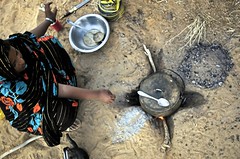
cooking

The same cooking methods are used in some parts of the world today.

The next post will explore the foods that were available to the New Testament cook, and how she might have served them.

What’s for dinner?

Next week’s posts examine a timeless topic: food and cooking. Three of the most challenging words for me are, “What’s for dinner?”  When we had a growing family, that was a common, and sometimes aggravating query. Now I find I ask myself that same question often. I have so many choices that just deciding a menu can be a challenge. I certainly have no excuse for serving dull and boring meals (though that sometimes happens).

While I have the luxury of having access to numerous varieties of produce, not just seasonally, but all year around, I wonder about shoppers in New Testament times. We’ll take a look at markets in Jerusalem, and visit rural areas as well.

And when I survey my kitchen with its gas stove and oven regulated by a thermostat, hot and cold running water, a refrigerator and freezer, cabinets stocked with everything to fill my cooking needs, I wonder what a well-equipped “kitchen” during the time of Martha and Mary might have looked like.

Have you wondered about cookbooks? I have two shelves filled with them. You might be surprised how far they date back. And what recipes are still used today.

Mary Hendren is researching the food that has been a staple from the beginning of time—bread. I love the smell of bread right out of the oven, especially if there is butter and honey handy. What a treat!

Bread in a traditional oven

Bread in a traditional oven (Photo credit: Wikipedia)

Well I hope that is enough of an “appetizer” to make you want to enjoy the “full course” next week.
Before I go, how about another Memory Checker: How many fruits and nuts can you list from the Bible? I have eleven so far.

Thanks for stopping by. This journey of discovery is much nicer in the company of friends!

Imagine

Imagine yourself a beautiful Jewish virgin named Esther living in Susa under the domination of the Persian Empire. Are you old enough to care that King Darius the Great is dead, and his son, Xerxes, now reigns?

Xerxes put down rebellions in Egypt and Babylon in less than a year! And now he has a grand design to conquer Greece. Perhaps Mordecai has spoken to you of these things. Do you worry that Xerxes is amassing a 100,000-man army and some of your friends could be conscripted? What will become of them? Where is Greece anyway? Do you know?

Chances are you’re thinking about something much more intriguing to your young mind. Can it be that Queen Vashti actually defied the King and refused to answer his summons? It’s being whispered everywhere. Are you relieved to learn that she was only deposed and not executed? After all, no one dares to disobey the king!

Are you watching this fateful day as King Xerxes reviews his troops amid fanfare and ceremony, and finally moves them forward toward Greece and victory? The roar of the crowd must be deafening. You’re surely amazed at the sheer number of men and boys, wagons, horses, armaments and supplies as they pass by and slowly fade from view.

Since there are no newspapers in your day, word of their progress travels on the lips of travelers and merchants, or by royal dispatches, rehearsed at stops along the way. Men like your uncle sit at the gate with ready ears hungry for news, some of them undoubtedly reliving glory days and heartache of battles long ago fought.

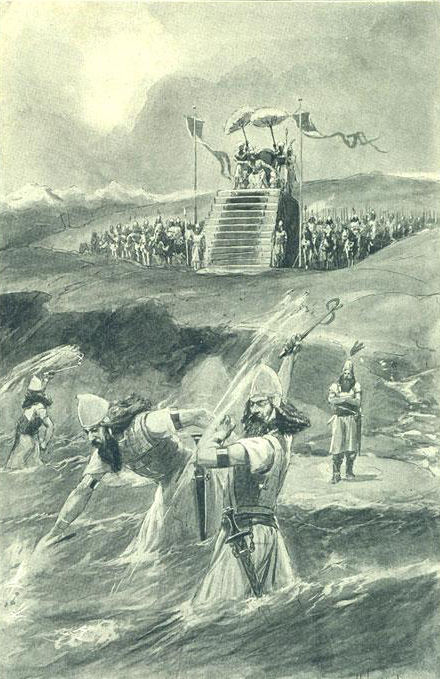
Xerxes lashing the Hellespont

Does Mordecai share news of the Hellespont disaster? A storm destroyed the bridge over its waters. Xerxes became so angry he ordered the scourging of the sea with a huge whip, and yelled, “Miserable monster! This is the punishment which Xerxes your master inflicts upon you, on account of the unprovoked and wanton injury you have done him.” How horrified you must be to learn the fate of the bridge engineers and workers—every one of them beheaded!

The king worships pagan gods. It is common knowledge. So when he decided to summon the gods to assure success before crossing the Strymon River, he first offered five white horses to the river, and then he offered human sacrifices—nine young men and nine young girls—burying them alive. Are you fearful, foreigner?

It is years later. The king returns in defeat and turns his attention to choosing a new queen. Suddenly you find yourself one of the many beautiful virgins sequestered in the harem precincts. All await the king’s decision. Are you delighted with your new regimen—the months of preparation with oils, and potions and perfumes? Surely you luxuriate in the finest garments and dazzling jewelry. Do you ever wonder if this is a blessing…or a curse?

Then it is your day, the day you become Queen. Xerxes, King of the Persian Empire, has chosen you, Esther, to reign by his side. You have your own domain, your servants, and your duties to attend. Life seems good.

Where there is power, there is intrigue, particularly in Xerxes’s palace. You are forced into a confrontation with the wicked Haman. Much hangs in the balance, and you must act wisely.

English: Esther Denouncing Haman, by Ernest No...

English: Esther Denouncing Haman, by Ernest Normand, c. 1915 (Photo credit: Wikipedia)

I see you more clearly now. I better understand the urgency of your calling for a fast to seek divine help, your resolute moving forward to save your people. I have an added dimension—the historical backdrop of your declaration, “If I perish, I perish.” We both know that could be a very real, distinct possibility.

Esther’s Make-over, Fit for a Queen

Each young woman’s turn came to go in to King Ahasuerus after she had completed twelve months’ preparation, according to the regulations for the women, for thus were the days of their preparation apportioned: six months with oil of myrrh, and six months with perfumes and preparations for beautifying women (Esther 2:12, NKJV).

Before a girl’s turn came to go in to King Xerxes, she had to complete twelve months of beauty treatments prescribed for the women, six months with oil of myrrh and six with perfumes and cosmetics (Esther 2:12, NIV).

Why did the young women go through such a lengthy beauty preparation?

The scripture does not answer the question of why the long beauty process, but it stresses that the procedures were “according to the regulations for the women.” Were the procedures known and practiced by women in general? Did mothers pass on recipes for soothing oils and perfumes to their daughters? It is likely women used oils and scents to some extent and taught their daughters how to make fragrances. But only the women inducted into the king’s harem would have had the luxury of a twelve-month beauty program.

Hegai, the king’s eunuch in charge of the harem, required all the candidates to undergo the twelve-month regimen; one could not opt out of the treatment. The words that form the basis of “beauty treatment” are translated “to scour, polish” (Expositor’s Bible Commentary, p. 804). In a dry climate subject to drought and water shortage, people did not bathe frequently. The twelve-month process might be thought of as a cleansing, hygienic exfoliation, followed by a refinement with fragrances.

Candidates for queen came to the king’s palace in Susa from “all the provinces of his kingdom” (Esther 2:2). The Persian Empire extended east toward India and west toward Greece. It encompassed expansive deserts and a sub-tropical area along the Tigris and Euphrates Rivers. The climate in most of the kingdom was hot, dry, desert or semi-desert. Droughts and shortage of rainfall were common. Weather along the two rivers was humid, but regions distant from the Tigris-Euphrates plain suffered blistering heat. Southern winds blowing off the Persian Gulf kicked up sandstorms, and dry winds blew down from the north.

One of Hegai’s objectives was to ameliorate the effects of heat, wind and evaporation.  His plan placed skin care first. Six months of oils addressed troublesome conditions such as cracking, wrinkling, wind damage, sunburn, healing of sores and skin diseases. Several of the oils available in Esther’s time had disinfectant and anti-fungal properties. Because every young woman underwent a thorough oil exfoliation, skin disorders were noted and treated. The king was protected from picking up skin diseases and infections that could have been introduced into the harem.

After six months of basic skin health care, Hegai’s attendants incorporated oils, spices and fragrances to enhance (polish) each girl’s natural beauty.  The scriptures do not say whether the cosmetics of Egypt such as kohl for the eyes, henna for hair color, pomegranate juice for blush and lip stain figured in the finishing process.

What oils were used in the beautifying process?

Although scripture doesn’t reveal much, it is thought that the women had daily massages with olive oil, cassis oil, myrrh oil and honey to moisturize, heal, disinfect and promote uplifting emotions.

Cassis berries

The on-line website Vision Smart Center in an article entitled “Super Cassis Power” states that cassis oil expressed from cassis berries has properties of settling PMS emotional flare-ups, bloating and cramps. It is used to relieve joint and body pain.

Olive oil is touted for its anti-oxidant and anti-inflammatory qualities. It soothes inflammation and heals burns. It softens skin texture and is thought by some to cure dandruff (Shop.Newsmax.com, “The Healing Powers of Olive Oil”).

As a natural humectant or moisturizer, honey plays a role in natural cosmetics today as well as in Esther’s time. It retains moisture, is mildly antiseptic, and has been found helpful in healing acne caused by hormonal changes (Benefits of Honey, “Favorite Tips on Natural Skin Care With Honey”).

English: Myrrh (Commiphora myrrha) Essential O...

English: Myrrh (Commiphora myrrha) Essential Oil in clear glass vial (Photo credit: Wikipedia)

Scripture lists myrrh oil first in the list of oils, and it may have been the most important ingredient in the regimen. In a YouTube presentation, Kenneth Gardner states that of the essential Biblical oils, myrrh is “top of the list” or “close to it.” He states that myrrh oil increases spiritual awareness and strengthens memory. It is effective in treating candida, yeast and ringworm (Young Living Essential Oils, “Myrrh Oil”).

Myrrh oil is derived from a resin that bleeds from a wound in the bark of a commiphora tree, native to Arabia and the eastern Mediterranean. The resin has been used for thousands of years as an ingredient in perfume, as incense and as a wound dressing (Wikipedia, “Myrrh”).

Ancient Egyptians “carried cones on their heads that contained myrrh to prevent sunburn and repel insects” (Experience-Essential-Oils.com, “Myrrh”). Myrrh is believed to have anti-aging and hormone-like properties. It is reported to stimulate circulation, decrease inflammation, soothe inflamed skin, prevent wrinkles, heal fungal infections, heal mouth sores, alleviate stretch marks, and repel parasites and insects (Women of Valor, “Skin Care in the Bible,” and Easy-Essential-Oils.com, “Myrrh oil”).

What is known about fragrant oils?

To make fragrant lubricants, women placed resins of myrrh, or any of a number of aromatic peels, leaves, petals, or spices such as cinnamon and saffron into stone bottles of oil. The bottles sat in the sun for several days. Each morning the aromatic matter was refreshed, until the scent had sufficiently infused the oil (Women of Valor, “Skin Care in the Bible”).

Are the ancient oils used beauty products today?

Many people believe the oils are effective, safe and desirable. The natural oils are free of carcinogens and chemicals that disturb metabolism. A number of the oils and aromatics listed in scripture are incorporated into lotions and creams.♥ Mary Hendren

Queen Vashti—Virtuous or Rebellious?

Esther 1:10-12

10 On the seventh day, when the heart of the king was merry with wine, he commanded Mehuman, Biztha, Harbona, Bigtha, Abagtha, Zethar, and Carcas, seven eunuchs who served in the presence of King Ahasuerus, 11 to bring Queen Vashti before the king, wearing her royal crown, in order to show her beauty to the people and the officials, for she was beautiful to behold. 12 But Queen Vashti refused to come at the king’s command brought by his eunuchs; therefore the king was furious, and his anger burned within him. NKJV

More to the story?

On the face of it this event looks like a rebellious wife who refuses the order of her husband/king. Is there more to the story? Yes, I believe there is.

The Woman’s Study Bible notes that Persian monarchs insisted on deference. “Not even the queen was allowed into the throne room unless summoned.” So for Vashti to refuse such an order was the height of disrespect and rebellion. She had to know that. Commentators have puzzled over her actions. Was she pregnant? Did she fear being ogled by a group of men? Was she a woman of nobility and character who refused an unjust command from her husband?

Historians note the reason for the 180-day spectacle mentioned in Esther 1 was for Xerxes to impress his officials and servants of his kingdom, and to present his grandiose plan to invade and conquer Greece. The culminating banquet featured “royal wine in abundance, according to the generosity of the king” (Esther 1:7-8). When Xerxes called for his wife to appear, several sources offer the possibility that he wanted to display Vashti as a trophy (my words), one of his most beautiful crowning possessions.

“Persian feasts were famous for their magnificence. Esther 1 gives a glimpse of the opulence of these feasts. It describes the common Persian manner of eating by reclining on couches or beds (vs 6), and it states that all drinking utensils were made of gold, no two being alike (vs 7). The Greek historian Xenophon said the Persians prided themselves on their number of drinking vessels. When the Greeks destroyed the Persian Empire, a part of their spoil consisted of golden drinking horns and cups” (Illustrated Manners and Customs of the Bible, Nelson, 1980, p. 157).

I found the following comment insightful: “The refusal of Vashti to obey an order which required her to make an indecent exposure of herself before a company of drunken revellers [sic] was becoming both to the modesty of her sex and her rank as queen; because, according to Persian customs, the queen, even more than the wives of other men, was secluded from the public gaze: and had not the king’s blood been heated with wine, or his reason overpowered by force of offended pride, he would have perceived that his own honour as well as hers was consulted by her dignified conduct” (from Jamieson, Fausset, and Brown Commentary, Electronic Database. Copyright © 1997, 2003 by Biblesoft, Inc. All rights reserved.)

McClintock and Strong’s Encyclopedia (article “Vashti”), citing Plutarch, says “that the kings of Persia have their legitimate wives to sit at table with them at their banquets; but that, when they choose to riot and drink, they send their wives away and call in the concubines and singing-girls. Hence, when the heart of Ahasuerus ‘was merry with wine,’ he sent for Vashti, looking upon her only as a concubine… .” (Biblesoft, Inc.)

There are more justifications put forth for her actions in other sources, but these seem enough to present her refusal to appear in a more complete context. Josephus writes that Xerxes later regretted his actions, but the laws of his empire did not accommodate a change of mind.

English: Queen Vashti Refuses to Obey Ahasueru...

English: Queen Vashti Refuses to Obey Ahasuerus’ Command (Est. 1:10-22) Русский: Царица Астинь не захотела придти по приказу царя Артаксеркса (Есф. 1:10-22) (Photo credit: Wikipedia)

Introducing Esther

Many people are familiar with the beautiful story of Esther—the brave young Jewess who put her life on the line to save her people. She is the stuff Hollywood is made of. In fact the 2006 movie, One Night with the King, was ninth on the list of highest-grossing motion pictures during the week it was released. This film received a 2007 CAMIE Award.

But who was she really?

A  Jewess

Edith Deen, in her book All the Women of the Bible (1955), introduces her as first “one of the humblest of figures, an orphan Jewess. But four years later she rises to the position of a queen of amazing power, a power which she manages to use wisely” (147).

Herbert Lockyer comments she “was related to a family carried away captive with Jeremiah, about 600 BC and was born of this family preferring to remain in the land of captivity rather than return to Jerusalem” (All the Women of the Bible, page 52).

An exile

Her Hebrew name was “Hadassah,” meaning “myrtle.” “Esther” is a Babylonian name meaning “star.” The Woman’s Study Bible mentions that a common practice during the Diaspora was to give an individual both a Babylonian and a Hebrew name (see note for Mordecai, Esther 2:5). Another example of this practice is found in Daniel 1:6-7.

An orphan

Esther 2:7  says that Hadassah had neither father nor mother.  Her cousin (or uncle, as Josephus puts forth) Mordecai took her as his daughter.

A beautiful virgin

When King Ahasuerus (afterwards referred to as Xerxes throughout) had a potential image problem due to the actions of his wife, Vashti, his counselors urged him to depose her and look for a new wife. An edict followed requiring virgins from all over the empire be brought to the capital city of Susa and the king’s palace so that a replacement could be chosen. Esther found herself among them.

Josephus records there were four hundred girls brought to the palace and Esther “was the most beautiful of all the rest, and that the grace of her countenance drew the eyes of the spectators principally upon her” (Antiquities of the Jews, Book 11, Chapter 6, 199).

A member of the royal harem

Esther 2:2 Let the beautiful young virgins be sought for the king:

“This was the usual way in which the harem or seraglio was furnished: the finest women in the land, whether of high or low birth, were sought out, and brought to the harem. They all became the king’s concubines: but one was raised, as chief wife or sultana, to the throne; and her issue was specially entitled to inherit.” (from Adam Clarke’s Commentary, Electronic Database. Copyright © 1996, 2003 by Biblesoft, Inc. All rights reserved.)

A queen

Having gone through the preliminary procedures required for entering the harem, Esther was selected as the king’s favorite, and became his queen. An indication as to her royal functions is contained in Esther 1:9, where Queen Vashti “also made a feast for the women in the royal palace which belonged to King Ahasuerus.” Queen Esther herself prepared banquets and entertained (Esther 5). Most importantly, she fulfilled the king’s desires.

In summary

The Woman’s Study Bible offers this observation concerning Esther:

“She was courageous and self-sacrificing (4:14, 16).

She was cleaver (5:3, 4; 8:3).

She was used of God to save her people.”

Esther, Queen of Persia

Setting:  Esther’s story occurs during the rule of the Persian Empire (559 BC-330 BC) approximately:

  • 50 years after the decree of Cyrus in 538 BC announcing that exiled Jews could return to Jerusalem (Ezra 1);
  • 40 years after the temple was rebuilt; and
  • 30 years before the rebuilding of the wall in Jerusalem, which is detailed in the book of Nehemiah.  [See Halley’s Bible Handbook.]
Der Wiederaufbau des Tempels zu Jerusalem unte...

Der Wiederaufbau des Tempels zu Jerusalem unter Esra und Nehemia. Feder in Schwarz über Spuren von Bleistift auf Velin. 14,8 x 14,3 cm. In brauner Feder monogrammiert “JSC” und mit schwarzer Feder datiert “d. 3 Apr. 47”. (Photo credit: Wikipedia)

It is helpful to read Ezra, Esther, and Nehemiah
as a unit to get the feel for the unfolding of momentous historical events during this period of time.

Timeline (Archaeological Study Bible, Esther, p 714):

586 BC  Fall of Jerusalem

539 BC  Persia’s conquest of Babylon

538 BC  First return of exiles to Jerusalem

486-465 BC  Xerxes’ reign in Persia

479 BC  Esther’s reign in Persia

458 BC  Ezra to Jerusalem

445 BC  Nehemiah to Jerusalem

445 BC  Jerusalem’s wall rebuilt

Map showing extent of Achaemenid Empire 559 - ...

Map showing extent of Achaemenid Empire 559 – 330 (BC) (Photo credit: Wikipedia)

A working schedule

Now with a couple of weeks logged in, I wanted to let you know the working plan for future posts. New material will post on the home page Mondays through Thursdays with additional information on the other pages as it applies or is relevant.

New URL

There is a new URL for this site: https://womenfromthebook.com/. It is my understanding that any attempts to connect via the old WordPress URL will automatically link to the new address.

Coming next week….

Next week we’ll take a look at the life of Queen Esther from a different angle.There is a back story to her statement, “If I perish, I perish” and I hope you will find the next posts (including another Q &A) interesting and revealing.

Until next time…

Thanks for checking in…nothing beats a journey of discovery in the company of friends!


Memory Checker Update

In a recent post, “Also Known As,” I mentioned there are at least six New Testament personalities who had their names changed, had nicknames, or were known by two names. Here is my list:

  • Simon/Peter (Matthew 4:18); Cephas (John 1:42)
  • James and John/ Boanerges or Sons of Thunder (Mark 3:17)
  • Joses/Barnabas (Acts 4:36)
  • Tabitha/Dorcas (Acts 9:36)
  • Simeon/Niger (Acts 13:1)
  • Saul/Paul (Acts 13:9)

Memory Checker Challenge

There are at least seven individuals in the Old Testament with name changes. What are their other names?

Abram (Genesis 17:5)

Sarai (Genesis 17:15)

Jacob (Genesis 32:28)

Naomi (Ruth 1:19-20)

Daniel (Dan. 1:6-7)

Hananiah

Mishael

Azariah

Can you think of more?

What’s in a name?

Wikipedia estimates there are 2600 proper names mentioned in the Bible. Whole studies have been done on Bible names and their meanings. The general consensus is that proper names emanated from such things as national heritage, religious influences, family characteristics, physical characteristics, or the names of natural objects such as plants and animals.

What about Tabitha, who is generally known as Dorcas?

English: Gazella dorcas neglecta (Dorcas gazel...

English: Gazella dorcas neglecta (Dorcas gazelle) in the Zoo de Madrid, Spain. Español: Gazella dorcas neglecta (gacela dorcas) en el Zoo Aquarium de Madrid, España. Galego: Gazella dorcas neglecta no Zoo Aquarium de Madrid, España. (Photo credit: Wikipedia)

Sources agree that the name Tabitha is the Aramaic form of the Hebrew name which means a “female gazelle.” The gazelle was regarded in the East, among both Jews and Arabs, as a standard of beauty. The word properly means “beauty.” Luke gives Dorcas as the Greek equivalent of the name.

Carol Meyers, General Editor of Women in Scripture (2000 “Tabitha”) comments: “The name [Tabitha] itself appears to have originated as a nickname, rather than as a proper name. Its use is attested in rabbinic traditions thought to date to the late first century C.E., where it appears to have been common among the slave population; it is possible that Tabitha herself was either a slave or a freedwoman of slave origins” (160).

Meyers’s comment peaked my curiosity, but since she does not cite her specific source regarding rabbinic traditions, and I have not been able to verify this, it remains just that—an interesting but thus far unsubstantiated possibility.