Author Archives: womenfromthebook

A Preview of Things to Come…

Illustrated Manners and Customs of the Bible says, “Hospitality, kindness to strangers, and ‘especially unto them who are of the household of faith’ (Gal. 6:10), had roots in the Old Testament and became an integral part of the teachings of the New Testament” (page 467).

The next several posts explore hospitality—how it’s defined in Bible times, demonstrations and expectations of the day. This promises to be a fascinating study, and we hope you’ll join us as we delve into the art and requirements of being hospitable.

How did you do? 

Giovanna Garzoni - Figs - WGA8492

Giovanna Garzoni – Figs – WGA8492 (Photo credit: Wikipedia)

The last Memory Checker asked how many fruits and nuts are listed in the Bible. Here’s my list:

  • Apples (Song of Solomon 2:5)
  • Almonds (Genesis 43:11; Numbers 17:8)
  • Figs (Nehemiah 13:15; Jeremiah 24:1-3)
  • Grapes (Leviticus 19:10; Deuteronomy 23:24)
  • Melons (Numbers 11:5; Isaiah 1:8)
  • Olives (Isaiah 17:6; Micah 6:15)
  • Pistachio Nuts (Genesis 43:11)
  • Pomegranates (Numbers 20:5; Deuteronomy 8:8)
  • Raisins (Numbers 6:3; 2 Samuel 6:19)
  • Sycamore Fruit (Amos 7:14)

In addition: Dates (II Chronicles 31:5). The marginal reference in the KJV indicates the word “honey” can be rendered “dates.” A syrup made from dates (or grapes, raisins, carob beans) is referred to as honey. (“Honey,” International Standard Bible Encyclopaedia)

Of Cookbooks and Recipes

Ancient cookbooks discovered

In wrapping up this series on food and cooking, I thought I’d share a couple of bits of trivia. In The Woman’s Study Bible, under the topic, “Cooking: What’s for Supper?” there is an interesting note about what is perhaps the world’s oldest cookbook. It consists of three clay tablets dating back about 4000 years. Following is one of the recipes:

“Take some meat. Prepare water; throw fat into it, then add leek and garlic, all crushed together, and some shuhutinnu [probably onion].”

The note continues that one tablet “has twenty-five recipes, including four vegetable dishes and twenty-one meat dishes (featuring deer, gazelle, lamb, pigeon, and wild dove).”

You might find the following links about ancient cookbooks and recipes interesting:

http://www.latimes.com/features/food/la-fo-050208-story,0,7456100.story

http://articles.latimes.com/1985-05-23/food/fo-8362_1_ancient-recipes

***

Have you tried….?

If your family is bored with your menus lately, perhaps you could suggest locusts, a food quite familiar in New Testament times. Joseph L. Gift, in his Life and Customs in Jesus’ Time, includes the following citation originally written in 1895 by Edmund Strapfer:

Desert locusts feeding.

Desert locusts feeding. (Photo credit: Wikipedia) Lunch on the wing

“Four kinds of locusts were edible. …We learn from the Arabs of our day how locusts are dressed for food. Sometimes they are simply roasted and eaten with a little water and salt….But usually, the preparation was more elaborate. After killing the locusts, they were dried in the sun; the head and claws were taken off and the body ground to a powder, either by a mill or in a mortar. Flour was mixed with this powder, and it was made into a sort of bread slightly bitter; camel’s milk or honey was added to correct this’” (page 21).

Locusts are commonly eaten in some parts of the world today.

The Staff of Life

For thousands of years bread has been a basic staple worldwide. In the past “most of the world has gotten most of its calories from bread” (Oman Tribune On-line, “Bread the Giver of Life”). The roots of the phrase “bread is the staff of life” may be the Bible. Bread is mentioned often in scripture as an important essential for life and hospitality. The verse that relates bread and the staff of life is Ezekiel 4:16. Here God warns Jerusalem about coming punishment.

Barley grain

Moreover he said unto me, Son of man, behold, I will break the staff of bread in Jerusalem.

Earlier God gave Ezekiel an intriguing list of grains and legumes that he was to make into bread.

Also take for yourself wheat, barley, beans, lentils, millet, and spelt; put them into one vessel, and make bread of them for yourself (Ezekiel 4:9).

Today’s artisan bread makers appreciate the nutritional value of Ezekiel’s grains. Peter Reinhardt notes that the whole grain movement of the 1960s led to improved bread in the United States. “Whole grains became the symbol of a healthful, holistic way of life that had fallen by the wayside” (Artisan Bread Every Day, Peter Reinhardt, Ten Speed Press, Berkeley, CA, p.1). He adds that “part of the problem was most of the whole grains of that era, while nutritionally superior, weren’t particularly delicious (or even palatable), so they came to be labeled ‘health food’ breads, not fit for general consumption” (same source, p.1).

The Food for Life Baking Company in California aims to make whole grain breads that are both nutritious and delicious. On their website, Food for Life states that the inspiration for their version of Ezekiel Bread is Holy Scripture. They add, “We discovered when these six grains and legumes (wheat, barley, beans, lentils, millet and spelt) are sprouted and combined, an amazing thing happens. A complete protein is created that closely parallels the protein found in milk and eggs.”

The company states that bread made from sprouted grain and baked at a lower temperature (as Ezekiel would have done) is less likely to aggravate allergies and gluten sensitivities. On the FAQ page, they qualify: “Many individuals with mild gluten sensitivities use sprouted grains with no adverse affect or allergic reaction…but every individual’s constitution is different.”

Author Suzanne Robin reminds readers, “Nowhere in book of Ezekiel does God suggest that everyone eat Ezekiel’s bread or that it has any particular health benefits. To obtain all the nutrients in a recommended 2000-a-er-day diet, you would have to consume 25 slices a day” (Livestrong.com, “Ezekiel Diet”). That’s a lot of bread!

It brings up the question of why God gave Ezekiel a recipe of grains and legumes with which to make bread? Was it to improve his strength? Was it to set an example of eating healthfully? Most Bible commentators agree that God’s purpose was not to promote health and nutrition.

Gill’s commentary states that most bread was made of wheat, and only in times of poverty did the bread include barley. The other grains God proscribed were primarily used for cattle feed. Only in a time of adversity would flour be stretched out with inferior ingredients. Henry’s commentary, Clarke’s commentary, and the Geneva commentary agree that Ezekiel ate a bread of mixed grains, not for health, but to enact a time of famine.

God measured the amount of bread Ezekiel could eat each day, and it was “the least a man could be kept alive with” (Henry’s Commentary, Ezekiel 4:9). Mixed grains indicated a scarcity in the necessities of life, a condition in which people “would be glad to eat whatever they could get” (Geneva Commentary, Ezekiel 4:9).

Although Ezekiel’s bread has some health-giving benefits and many people choose to incorporate it as part of their diet, Ezekiel did not eat it by choice. God sustained his life at a level of near starvation. He ate the bread of adversity in obedience to God for the purpose of enacting a coming famine in Jerusalem. ♦ Mary Hendren

Breaking Bread

That most bread is sliced, soft and wrapped for freshness saves time. With sliced bread you can put together a quick meal and eat on the run. Sliced bread makes great sandwiches that can be cut into portions, and kids make their own snacks and lunches with sliced bread. The words “sliced bread” have become a motto for innovation. “There’s nothing like it since ‘sliced bread.’”

English: cadifus

English: cadifus (Photo credit: Wikipedia)

With the popularity and convenience of sliced bread, we may have forgotten that in times past the act of breaking bread, not slicing it, symbolized eating together and hospitality. Originally “breaking bread” meant the literal breaking of a loaf of bread. In time the phrase “breaking bread” expanded to mean, “to engage in a comfortable, friendly interaction” over a shared eating experience (Urbandictionary.com, “Breaking Bread”).

The phrase is “a standard Jewish expression from pre-Christian times which refers specifically to the action of ‘breaking bread’ at the commencement of a meal, and then by extension, to the meal itself” (The New Testament Speaks, “The Meaning of ‘Breaking Bread’” on-line resource).

Customarily the father or an honored guest usually broke the loaf at a meal and asked a blessing over it. The family and guests shared a common meal, taking their portion from the broken loaf—ideally joined for a brief time in the pleasure of eating and conversation.

On many occasions Jesus broke and blessed bread: when He fed four thousand followers (Matthew 15:35-36), when He fed the five thousand (Matthew 14:19), when He instituted the new Passover symbols (Matthew 26:26). Jesus, as the honored guest of Lazarus, Mary and Martha, would likely have broken the bread at the meal He ate with them (Luke 10:38-42). When Jesus ate with two disciples on the way to Emmaus, He assumed the honored role and broke bread at their meal.

Now as it came to pass, as He sat at the table with them, that He took bread, blessed and broke it, and gave it to them. Then their eyes were opened and they knew Him; and He vanished from their sight (Luke 24:30-31).

Breaking bread was a meaningful practice in which an honored father or guest broke the loaf of bread, the essential “staff of life.”  In asking the blessing over the bread and the meal to follow, he acknowledged God as the Provider of life’s essentials and of life itself.

We will probably continue buying loaves of sliced bread for convenience. At times we should buy or bake a crusty baguette, break off a hunk, hear the crust shatter, and enjoy the uneven nooks and crannies.  ♥ Mary Hendren

Age-old Question: What’s to Eat?

The first-century wife in Palestine—I’ll call her Martha—faced the same daily challenge that we moderns do: what to feed her family. She didn’t know about a nutritional pyramid like the one designed by the Harvard School of Public Health, but Martha made her choices loosely based on that scheme nonetheless: meat, milk, grains, veggies, and fruit.

Bread

At the top of her list of menu staples was bread, usually made from wheat or barley. Every morning Martha poured grain into her mill, turned the handle with the help of her daughter, and watched the flour pour from between its discs. Sometimes she sifted it and ground it again to get the fineness she desired.

Then, as automatically as getting up in the morning, Martha added water, salt, and a lump of leavened dough saved back from the day before. She kneaded the mixture into pliant dough, and put it in a warm place to rise for a few hours. Finally she shaped the dough into flat loaves and baked them in a clay oven in her courtyard. These loaves would find their way into lunches and dinners.

The word “bread” is found 84 times in the New Testament and 346 times in the whole Bible, which attests to its importance. Some types mentioned are: showbread, unleavened bread, wafers (Exodus 16:31), cracknels (KJV) or cakes (I Kings 14:3), and the ubiquitous leavened bread.

Meat

Red meat was a treat, and on special occasions Martha would cook beef, goat, lamb, or occasionally, wild game. Fish was a favorite food in Palestine, and large quantities were caught in the Sea of Galilee. It was cooked and eaten immediately, or salted and dried to be eaten at a later date. (See Mark 8:1-9; John 21:1-13.)

Milk products

Martha did not have the luxury of refrigeration, so she often churned milk into curds or butter, or made a type of cheese. Chances are that none of these would taste familiar or be especially pleasurable to our “refined” palates.

Vegetables and fruits

Martha grew many of her own vegetables, regularly carrying water from the well to keep her plants alive. She dried beans, lentils and peas, storing them in clay jars. In August and September, she looked forward to the fruit harvest of grapes, figs, and pomegranates. The local market was sure to have a good selection of what she could not grow herself.

Olive Oil

The fruit of the olive tree was harvested in the fall and then pressed into olive oil to be used in cooking, for fueling lamps, grooming the hair and skin, and for religious rites. Martha kept hers in a small earthenware container called a cruse.

Olives

Olives (Photo credit: wollombi)

Salt and spices

While Martha used salt (probably obtained from the Dead Sea area) to season her food, more importantly she used it to preserve food such as fish. She also used herbs and spices such as cumin, dill, mustard, parsley, sage, thyme, and mint to add a special dash of flavor to add welcome variety to her menu for the day.

Honey

Honey, the sweetener mentioned throughout the Bible, was harvested from the hives of wild bees. Martha occasionally made another type of  “honey” by boiling dates and locust beans to make a syrup.

***

While Martha may have used other foods to supplement her family’s meals, the  foods listed above appeared regularly on her table.

A Typical Day for a New Testament Woman

If there is a constant throughout history it is the need for food and water for survival. And generally speaking women have been at least partially responsible for making sure the family has both. In the 21st Century, this is a much easier task for most areas of the developed world. Water is piped into the house, and food is as near as the closest grocery. Not so for village women in New Testament times, as we shall see.

Water

Sun-up signals the time for daily household tasks to begin. A wife and her daughters are responsible for providing fresh water for the home. So they make daily trips to the village well in the early morning and in the evenings, carrying pitchers of water on their heads or shoulders. If larger quantities of water are needed, men use large sheep or goat skins to carry the supply.

Fred H. Wight, in his Manners and Customs of the Bible (1953), says “each woman who comes for water brings with her, in addition to the pitcher…a hard leather portable bucket with a rope, in order to let it down to the level of the water” (page 90). (See John 4:5-13.)

Meals

Then they busy themselves with food preparation for the day: grinding grain; baking bread; milking the goats; and making cheese and curds. (Mary Hendren will explain more about bread in her posts, “Breaking Bread,” and “The Staff of Life.”)

“Most families ate two meals. Breakfasts were likely to be light and were carried to the fields…and eaten at mid-morning or midday” (Reader’s Digest: Jesus and His Times, page 97). Supper was relaxation time after a hard day’s labor and the meal was substantial: “vegetables, eggs, cheese, bread, butter, wine, nuts, and fruit, with occasional chicken or wild fowl.”

Cooking

In warm weather cooking is done in the courtyard, but during inclement weather the cook resorts to using a portable clay stove inside. Since there is no chimney, smoke and cooking odors permeate the small house.

Most foods other than bread are boiled or stewed in a big pot and seasoned with salt and onions, garlic, mint, dill, cumin, coriander, rue, or mustard.

Dishes

Wight writes that the only dishes at a meal are those containing the food, such as a pot for stew. There are no plates for individuals, or silverware. Bread is used to scoop food from the common pot, and meat is eaten with the fingers (pages 58-60). (See Matthew 26:23; Mark 14:20.)

Washing hands

The rules of the  culture require that hands be washed before and after a meal. This is done by pouring water over the hands into a basin and then discarding it appropriately. Wealthier family have servants who assist in this activity.

At day’s end

After a full day of work for the entire family, mattresses are pulled out, and mother, father and children settle in together for a night’s rest. At daybreak, the cycle begins again.

In the beginning—food!

As I think about the topic of food, a hazy scenario comes to mind. Imagine Adam and Eve, newly created human beings, eying a dazzling array of food—not genetically-altered, not flavor-enhanced, not vitamin-enriched. Just perfect, exquisite food in a garden “planted” by their Creator, on wing or hoof, or in pristine waters.

Heade Martin Johnson Hummingbird And Apple Blo...

Heade Martin Johnson Hummingbird And Apple Blossoms (Photo credit: Wikipedia)

Was there a learning curve for them? God specified which foods were proper to eat, but did He show them how to prepare them? Imagine the sensual delight as they touched and tasted and smelled first one kind of food and then another for the very first time!

Judging by the fateful encounter of Eve with the serpent, it seems there was mature fruit on the trees in the garden shortly after her creation. Were grains ready for harvest, and olives ready to be pressed for their multipurpose oil—both foods that would be staples for generations to come? There is no way of knowing, of course, but one thing is for sure. God provided them with all the food they and their offspring needed, and we enjoy it even to this day.

New Testament Times: The Average Village Home

As we begin the series on food and cooking, I want to give the reader a feel for a New Testament woman’s base of operation, the home. Research shows this varies from cities to villages. For now we’ll look mainly at the homes of ordinary working people, most of whom were of modest means.

The New Testament home

The home of the average village dweller in the days of Christ was spartan by today’s Western standards. Quite likely it consisted of only one room. If there were more, they were connected at the corners by walls in such a manner as to eventually form an inner courtyard. [Wealthier people, most likely city dwellers, had houses built Roman-style with two rectangular courtyards, one behind the other, each surrounded by rooms. They also featured centrally heated bathrooms with a hot water supply and tubs set into the floor (The Lion Encyclopedia of the Bible, Pat Alexander, Ed., 1978).]

The floor was usually earthen, but a better home could feature one of finely crushed stone, or one made of brick.

There were only one or two small windows. Lamps supplemented existing natural light during the day, and provided light at night. Without any type of  streetlights, these villages must have been very dark indeed.

There were no facilities for bathing.

Essentials

Every house had the following bare essentials:

  • Lamps. These were some of the most important items in a home. Potters fashioned lamps completely covered over with a small hole for oil (commonly olive oil or animal fat), and a spout for the wick (strips of flax or rag).
An Ancient Roman oil lamp, showing the Jewish ...

An Ancient Roman oil lamp, showing the Jewish menorah, on display at the Museo nazionale archeologico ed etnografico “G. A. Sanna” at Sassari, Italy. (Photo credit: Wikipedia)

  • A bushel. This container usually held about a peck, and served as a dry measure for grains and other items. It could also be turned upside down to become a table for light meals, or serve as a low lamp stand.
  • Wine skins. These were goatskins with the hair side in. The openings were tied shut, and a spout or stopper was placed in the neck.
  • Brooms. Made of corn stalks, these were kept with the father’s tools.
  • A mill. It was an essential to the life of the family. One of the most common sights in the village was of two women grinding grain into flour. (See Matthew 24:41.)

The hand mill consisted of two circular stones, the lower of which was larger and had a spike which pierced the center of the smaller one on top. Grain was poured into the central hole, and the women turned the top stone with a handle. Flour poured out from between the two stones.

The mill was so important that it was protected by law: “No man shall take the lower or the upper millstone in pledge: for he takes one’s living in pledge” (Deuteronomy 24:6).

The furnishings

In the average village home, furnishings were limited, consisting of a “table” (often simply a straw mat laid out on the raised floor), and possibly something to sit on. Beds were thin wool-filled mattresses which were rolled out each evening, and rolled up the next morning. The whole family slept together with the mother on one end, the father at the other, and any children in between. (See Luke 11:5-8.)

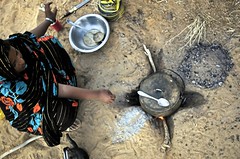
The “stove” took the form of a fire made in the earthen floor or in an earthenware pot.

Cooking equipment

Part of the cook’s equipment included a convex baking sheet, which could be put over the fire, and a cooking-pot, which could stand in the fire. She also used an assortment of pottery items—jugs, jars, and bowls in varying sizes. Wealthier homes used decorated glass items, but this was beyond the means of the average household. (Ibid.)

cooking

The same cooking methods are used in some parts of the world today.

The next post will explore the foods that were available to the New Testament cook, and how she might have served them.

What’s for dinner?

Next week’s posts examine a timeless topic: food and cooking. Three of the most challenging words for me are, “What’s for dinner?”  When we had a growing family, that was a common, and sometimes aggravating query. Now I find I ask myself that same question often. I have so many choices that just deciding a menu can be a challenge. I certainly have no excuse for serving dull and boring meals (though that sometimes happens).

While I have the luxury of having access to numerous varieties of produce, not just seasonally, but all year around, I wonder about shoppers in New Testament times. We’ll take a look at markets in Jerusalem, and visit rural areas as well.

And when I survey my kitchen with its gas stove and oven regulated by a thermostat, hot and cold running water, a refrigerator and freezer, cabinets stocked with everything to fill my cooking needs, I wonder what a well-equipped “kitchen” during the time of Martha and Mary might have looked like.

Have you wondered about cookbooks? I have two shelves filled with them. You might be surprised how far they date back. And what recipes are still used today.

Mary Hendren is researching the food that has been a staple from the beginning of time—bread. I love the smell of bread right out of the oven, especially if there is butter and honey handy. What a treat!

Bread in a traditional oven

Bread in a traditional oven (Photo credit: Wikipedia)

Well I hope that is enough of an “appetizer” to make you want to enjoy the “full course” next week.
Before I go, how about another Memory Checker: How many fruits and nuts can you list from the Bible? I have eleven so far.

Thanks for stopping by. This journey of discovery is much nicer in the company of friends!

Imagine

Imagine yourself a beautiful Jewish virgin named Esther living in Susa under the domination of the Persian Empire. Are you old enough to care that King Darius the Great is dead, and his son, Xerxes, now reigns?

Xerxes put down rebellions in Egypt and Babylon in less than a year! And now he has a grand design to conquer Greece. Perhaps Mordecai has spoken to you of these things. Do you worry that Xerxes is amassing a 100,000-man army and some of your friends could be conscripted? What will become of them? Where is Greece anyway? Do you know?

Chances are you’re thinking about something much more intriguing to your young mind. Can it be that Queen Vashti actually defied the King and refused to answer his summons? It’s being whispered everywhere. Are you relieved to learn that she was only deposed and not executed? After all, no one dares to disobey the king!

Are you watching this fateful day as King Xerxes reviews his troops amid fanfare and ceremony, and finally moves them forward toward Greece and victory? The roar of the crowd must be deafening. You’re surely amazed at the sheer number of men and boys, wagons, horses, armaments and supplies as they pass by and slowly fade from view.

Since there are no newspapers in your day, word of their progress travels on the lips of travelers and merchants, or by royal dispatches, rehearsed at stops along the way. Men like your uncle sit at the gate with ready ears hungry for news, some of them undoubtedly reliving glory days and heartache of battles long ago fought.

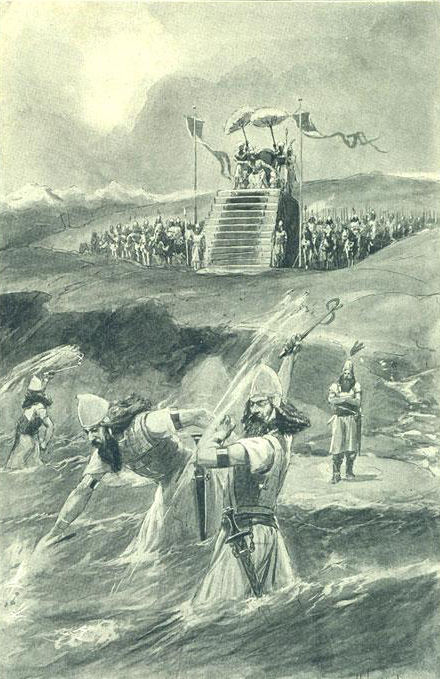
Xerxes lashing the Hellespont

Does Mordecai share news of the Hellespont disaster? A storm destroyed the bridge over its waters. Xerxes became so angry he ordered the scourging of the sea with a huge whip, and yelled, “Miserable monster! This is the punishment which Xerxes your master inflicts upon you, on account of the unprovoked and wanton injury you have done him.” How horrified you must be to learn the fate of the bridge engineers and workers—every one of them beheaded!

The king worships pagan gods. It is common knowledge. So when he decided to summon the gods to assure success before crossing the Strymon River, he first offered five white horses to the river, and then he offered human sacrifices—nine young men and nine young girls—burying them alive. Are you fearful, foreigner?

It is years later. The king returns in defeat and turns his attention to choosing a new queen. Suddenly you find yourself one of the many beautiful virgins sequestered in the harem precincts. All await the king’s decision. Are you delighted with your new regimen—the months of preparation with oils, and potions and perfumes? Surely you luxuriate in the finest garments and dazzling jewelry. Do you ever wonder if this is a blessing…or a curse?

Then it is your day, the day you become Queen. Xerxes, King of the Persian Empire, has chosen you, Esther, to reign by his side. You have your own domain, your servants, and your duties to attend. Life seems good.

Where there is power, there is intrigue, particularly in Xerxes’s palace. You are forced into a confrontation with the wicked Haman. Much hangs in the balance, and you must act wisely.

English: Esther Denouncing Haman, by Ernest No...

English: Esther Denouncing Haman, by Ernest Normand, c. 1915 (Photo credit: Wikipedia)

I see you more clearly now. I better understand the urgency of your calling for a fast to seek divine help, your resolute moving forward to save your people. I have an added dimension—the historical backdrop of your declaration, “If I perish, I perish.” We both know that could be a very real, distinct possibility.